

Table of Contents
- What is Greek for Professionals?
- Who is this course for?
- Business Greek vs General Greek
- What will you learn?
- Course levels: from A1 to C2
- Online and in-person Greek courses for professionals
- Methodology: practical, experiential and communication-based
- Examples of professional Greek scenarios
- Greek for specific professions
- Greek for work in Thessaloniki
- Connection with the Certificate of Attainment in Greek
- How long does it take to learn Greek for professional use?
- Why choose Philoxenia Greek Language School?
- Internal learning path
- Start learning Greek for your professional life
- Frequently Asked Questions about Greek for Professionals
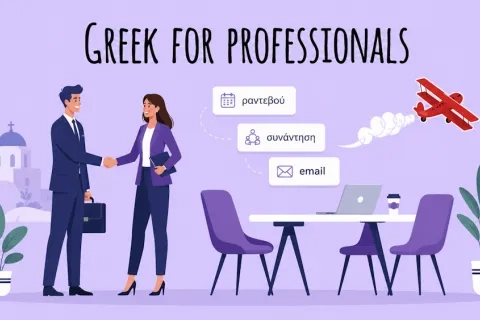
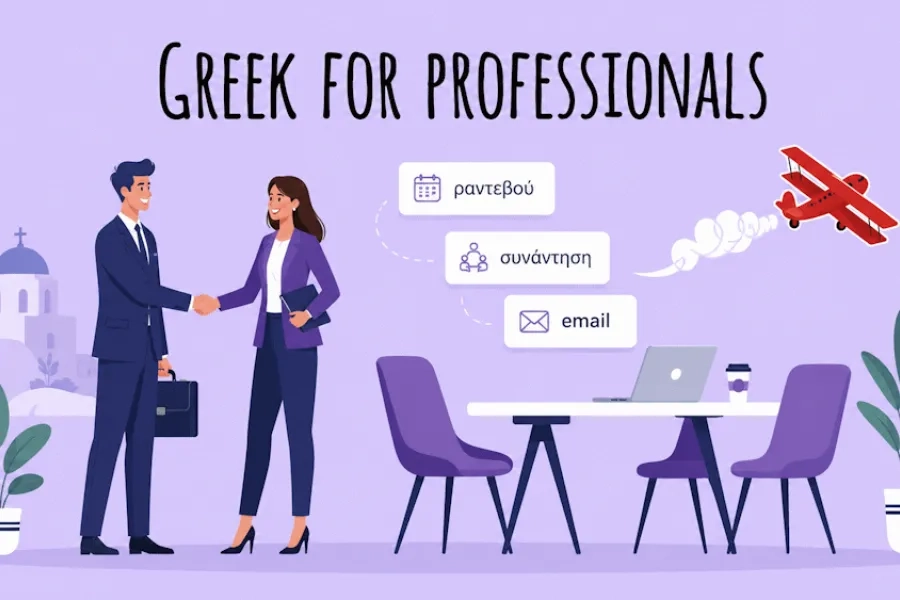
Greek for Professionals is a focused Greek language program for adults who need Greek for work, business, official communication and everyday professional life in Greece. At Philoxenia Greek Language School in Thessaloniki, the course is designed for foreign professionals, employees, entrepreneurs, digital nomads, Erasmus trainees and adults who want to use Greek with confidence in real professional situations.
This is not a general Greek course with a few business words added. It is a practical, goal-oriented learning path that helps you communicate in Greek at work: writing emails, speaking with clients, arranging appointments, understanding workplace instructions, participating in meetings, handling phone calls and navigating basic administrative procedures.
You can attend the course in Thessaloniki, online, or through private lessons adapted to your professional field, schedule and language level.
What is Greek for Professionals?
Greek for Professionals is a specialized Greek course that teaches the language you need for work, business and formal everyday communication in Greece.
In a general Greek course, students usually learn broad vocabulary for daily life, travel, shopping, social interaction and grammar progression. In a professional Greek course, the focus becomes more specific: how to speak politely, clearly and appropriately in workplace contexts.
The course may include:
- workplace vocabulary and expressions;
- formal and semi-formal communication;
- emails, messages and written requests;
- phone calls and appointment setting;
- customer and client interaction;
- interviews and professional self-presentation;
- Greek for public services and basic administrative procedures;
- sector-specific vocabulary depending on the learner’s needs.
For example, a learner working in hospitality may need Greek for reservations, guest communication and complaints. A healthcare professional may need vocabulary for appointments, symptoms and patient interaction. A real estate consultant may need Greek for property descriptions, contracts and client meetings. A business owner may need Greek for suppliers, invoices, services and negotiations.
At Philoxenia, the content is adapted according to the learner’s real professional goals.
Who is this course for?
This course is for adults who need Greek as a working language, not only as a cultural or travel language.
The program is suitable for:
- foreign professionals living or working in Greece;
- expats who need Greek for their professional integration;
- digital nomads based in Thessaloniki or elsewhere in Greece;
- Erasmus trainees and interns;
- entrepreneurs and small business owners;
- employees in tourism, hospitality, healthcare, education, real estate, NGOs or administration;
- academics, researchers and university staff;
- professionals preparing for interviews or workplace communication in Greek;
- learners who already know basic Greek but do not feel confident in professional situations.
Many learners can order coffee or introduce themselves in Greek, but they hesitate when the context becomes professional. They may understand daily conversation but struggle with formal vocabulary, polite structures, written messages or phone communication. This course closes that gap.
Business Greek vs General Greek
Business Greek focuses on professional communication, while general Greek builds broader language ability for everyday life, travel, culture and social interaction.
| Area | General Greek | Business & Professional Greek |
|---|---|---|
| Main goal | Everyday communication | Workplace and professional communication |
| Vocabulary | Daily life, travel, culture, social topics | Work, business, services, meetings, emails, administration |
| Speaking practice | Social dialogues and daily situations | Calls, meetings, interviews, client interaction |
| Writing | Basic messages and short texts | Emails, requests, confirmations, professional messages |
| Tone | Informal and everyday | Polite, formal and semi-formal |
| Best for | Learners who want broad Greek skills | Learners who need Greek for work in Greece |
The two areas are connected. A professional learner still needs strong foundations in grammar, pronunciation and everyday vocabulary. However, the professional course gives extra attention to the contexts where language affects work, trust, clarity and professional image.
What will you learn?
You will learn how to use Greek in real professional situations with accuracy, confidence and cultural awareness.
The exact syllabus depends on your level and goals, but the course may include the following learning areas:
| Learning Area | Practical Outcome |
|---|---|
| Professional introductions | Present yourself, your role, your company or your background |
| Workplace vocabulary | Understand and use words related to your professional field |
| Emails and written messages | Write clear, polite and structured Greek communication |
| Phone communication | Make appointments, confirm details and ask for clarification |
| Meetings | Express opinions, ask questions and participate in discussions |
| Client interaction | Welcome, inform, explain, respond and solve basic problems |
| Interviews | Talk about experience, skills, availability and professional goals |
| Administrative Greek | Understand basic forms, requests, documents and public-service language |
| Formality and politeness | Choose the right tone for professional communication |
| Sector-specific Greek | Build vocabulary for your work area or business activity |
The aim is not only to memorize words. The aim is to use Greek naturally and appropriately in situations where communication matters.
Course levels: from A1 to C2
Professional Greek can be adapted from A1 to C2, but the learning goals change according to the learner’s level.
At A1–A2, the focus is on practical survival communication for the workplace. Learners build basic phrases, simple professional vocabulary and essential grammar for everyday work-related situations.
At B1–B2, the course becomes more functional and independent. Learners practice longer conversations, written communication, workplace scenarios, professional opinions and sector-specific vocabulary.
At C1–C2, the focus shifts to advanced fluency, precision, formal style, complex texts, presentations, negotiation, academic or high-level professional communication.
A1–A2: Professional survival Greek
At beginner level, learners work on simple but useful communication:
- introducing themselves and their profession;
- saying where they work and what they do;
- understanding basic instructions;
- making simple appointments;
- asking for repetition or clarification;
- using polite expressions;
- writing short professional messages.
B1–B2: Independent workplace communication
At intermediate level, learners develop more autonomy:
- explaining professional experience;
- writing structured emails;
- speaking with clients or colleagues;
- understanding workplace conversations;
- participating in simple meetings;
- giving opinions and suggestions;
- handling common problems in Greek.
C1–C2: Advanced professional fluency
At advanced level, learners focus on precision and style:
- formal and persuasive communication;
- complex written texts;
- presentations and public speaking;
- specialized terminology;
- professional argumentation;
- negotiation and conflict resolution;
- academic or institutional Greek.
Online and in-person Greek courses for professionals
Philoxenia offers flexible learning formats for professionals who need practical Greek without losing time or focus.
The course can be organized in different ways:
| Format | Best for |
|---|---|
| In-person lessons in Thessaloniki | Learners living in the city who want classroom interaction |
| Online Greek lessons | Professionals outside Thessaloniki or with limited availability |
| Private Greek lessons | Learners with specific professional goals or irregular schedules |
| Intensive Greek courses | Learners who want structured progress over a longer academic cycle |
| Superintensive Greek courses | Learners who need faster progress in a shorter period |
| Hybrid learning | Learners who combine travel, work and flexible study |
For many professionals, private or small-group formats are the most effective option because the syllabus can be adapted to the learner’s work sector. A lawyer, a doctor, a hotel employee and a software engineer do not need exactly the same Greek. They need the same foundations, but different vocabulary, dialogues and real-life scenarios.
Methodology: practical, experiential and communication-based
The course is based on real communication, practical tasks and experiential learning rather than passive memorization.
At Philoxenia, Greek is taught as a living language. Grammar is not isolated from communication; it becomes a tool for speaking, writing and understanding real situations. Students practice with scenarios that reflect professional life in Greece.
A lesson may include:
- a short grammar focus connected to workplace use;
- vocabulary building through real examples;
- role-play with professional scenarios;
- guided speaking practice;
- correction of pronunciation and sentence structure;
- email or message writing;
- listening practice with authentic or semi-authentic dialogues;
- feedback and personalized homework.
For example, instead of only learning the verb “κλείνω” in theory, a learner may practice how to say:
“Θα ήθελα να κλείσω ένα ραντεβού.”
“I would like to make an appointment.”
“Μπορούμε να το κλείσουμε για την Τρίτη;”
“Can we schedule it for Tuesday?”
This is how grammar becomes practical communication.
Examples of professional Greek scenarios
The course uses realistic workplace scenarios so that students can immediately apply what they learn.
Typical scenarios include:
Emails and messages
Students learn how to write short, clear and polite messages in Greek, such as confirmations, requests, follow-ups and simple professional explanations.
Examples:
- confirming an appointment;
- asking for information;
- sending a polite reminder;
- explaining availability;
- requesting documents;
- responding to a client or colleague.
Phone calls
Phone communication is often one of the most difficult skills for Greek learners because there are no visual clues. The course includes structured phone practice with useful phrases and repetition strategies.
Students practice how to:
- introduce themselves;
- ask to speak with someone;
- confirm dates and times;
- ask for clarification;
- leave a message;
- end a call politely.
Meetings and workplace discussions
At intermediate and advanced levels, students practice how to participate in professional conversations.
They learn how to:
- express an opinion;
- agree or disagree politely;
- ask questions;
- clarify a point;
- present an idea;
- summarize next steps.
Client and customer communication
For learners working in services, tourism, hospitality, retail, education or consulting, client communication is essential.
The course may include:
- welcoming a client;
- explaining a service;
- giving directions;
- responding to questions;
- handling simple complaints;
- offering alternatives;
- using polite and professional tone.
Greek for specific professions
Professional Greek works best when it is connected to the learner’s actual field.
Depending on the student’s needs, lessons may include vocabulary and scenarios for:
- tourism and hospitality;
- restaurants, cafés and customer service;
- healthcare and care services;
- education and academic life;
- real estate and property management;
- business and entrepreneurship;
- NGOs and social work;
- administration and public services;
- technology and remote work;
- retail and commercial communication.
This makes the course especially useful for professionals who already live in Greece and face Greek-language situations in their daily work.
Greek for work in Thessaloniki
Learning Greek in Thessaloniki gives professionals direct access to the language of everyday business, services and local life.
Thessaloniki is a dynamic city with universities, tourism, culture, entrepreneurship and a growing international community. For foreign professionals, speaking Greek can make daily work easier and professional relationships stronger.
Even when English is used in many contexts, Greek remains important for:
- building trust with local clients and partners;
- understanding everyday workplace communication;
- dealing with public services;
- reading signs, forms and basic documents;
- participating more fully in local professional life;
- feeling more confident in the city.
Philoxenia Greek Language School is located in the center of Thessaloniki, at Egnatia 45, making it accessible for learners who work or live in the city center.
Connection with the Certificate of Attainment in Greek
Learners who need official proof of Greek proficiency can also prepare for the Certificate of Attainment in Greek.
The Certificate of Attainment in Greek, often known as Ellinomatheia, is the official certification of Greek language proficiency. It is aligned with CEFR levels and assesses core skills such as listening, reading, speaking, writing and language awareness.
For professional learners, certification may be useful for:
- academic or professional applications;
- documentation of Greek language ability;
- long-term residence or integration goals;
- personal confidence and structured progress;
- future career opportunities in Greece.
There is also a specific relevance for learners interested in A2 Greek for professional purposes, depending on their goals and examination pathway. Philoxenia can support learners with level assessment, preparation strategy and structured language development.
How long does it take to learn Greek for professional use?
The time needed depends on your starting level, target level, weekly study rhythm and professional goals.
A beginner who needs basic workplace Greek will need a different learning plan from an intermediate learner who wants to write professional emails or speak in meetings. For this reason, a placement test or initial evaluation is important before choosing the best format.
As a general orientation:
| Starting Point | Typical Goal | Recommended Format |
|---|---|---|
| Complete beginner | Basic workplace phrases and survival communication | A1 course + professional vocabulary |
| A1/A2 learner | More confidence in daily work situations | Private or small-group professional Greek |
| B1 learner | Emails, calls, meetings, client communication | Business & Professional Greek course |
| B2+ learner | Advanced fluency, formal writing, presentations | Tailor-made private lessons |
| Urgent professional need | Faster progress in limited time | Intensive or superintensive structure |
The most effective approach is usually a combination of structured Greek learning and professional scenario practice.
Why choose Philoxenia Greek Language School?
Philoxenia combines structured Greek language teaching with real-life communication, cultural understanding and a human-centered learning environment.
The name Philoxenia means “love of the stranger” and expresses the philosophy behind the school: language learning as connection, participation and belonging. Students do not learn Greek only as grammar; they learn it as a living language used in the streets, workplaces, cafés, services and communities of Greece.
Philoxenia offers:
- Greek courses for all levels, from A1 to C2;
- in-person Greek lessons in Thessaloniki;
- online Greek courses for learners anywhere;
- private lessons for specific professional goals;
- intensive and superintensive learning options;
- preparation support for Greek language certification;
- experiential learning connected to real life in Greece;
- a central location in Thessaloniki;
- a warm, international learning environment.
For professionals, this combination matters. You need structure, but you also need practical confidence. You need grammar, but you also need tone, context and cultural awareness. You need vocabulary, but you also need to know when and how to use it.
Internal learning path
If you are not sure where to begin, start with a Greek placement test.
Recommended path:
- Take the free Greek placement test.
- Discuss your professional goals with the school.
- Choose the right format: private, online, in-person, intensive or superintensive.
- Build your general Greek foundation.
- Add professional vocabulary and workplace scenarios.
- Practice with real tasks: emails, calls, meetings and client communication.
- Review progress and adjust the learning plan.
Suggested internal links:
- Free Greek Placement Test
- Business & Professional Greek for Work
- Private Greek Lessons
- Online Greek Courses
- Intensive Greek Courses
- Certificate of Attainment in Greek Preparation
Start learning Greek for your professional life
Greek for Professionals helps you use Greek where it matters: at work, in meetings, in emails, with clients, with colleagues and in everyday professional life in Greece.
Whether you live in Thessaloniki, work remotely, plan to move to Greece or need Greek for your current job, Philoxenia Greek Language School can help you build a practical and realistic learning path.
Book a placement test or contact us to discuss the right Business & Professional Greek course for your goals.
FAQ
Frequently Asked Questions about Greek for Professionals
Clear answers about Greek for Professionals, Business Greek, online lessons, workplace communication, professional emails, certification support and learning Greek for work in Greece.
How can I learn Greek for professional use in Greece?
You can learn Greek for professional use through a focused course that combines general Greek foundations with workplace vocabulary and real communication tasks. At Philoxenia Greek Language School, lessons can include emails, meetings, phone calls, client interaction and professional role-play.
What is the difference between Business Greek and general Greek lessons?
Business Greek focuses on work-related communication, while general Greek covers broader everyday language. A professional Greek course gives extra attention to formal tone, workplace vocabulary, emails, meetings, appointments, client communication and practical language used in professional life.
Can beginners take Greek for Professionals if they only know basic Greek?
Yes, beginners can start Greek for Professionals, but they usually begin with essential A1 foundations first. Professional vocabulary is introduced gradually through simple workplace situations, polite phrases, short dialogues and practical communication tasks.
What level of Greek do I need for professional emails and meetings?
Simple professional emails can begin at A2 level, while more independent workplace writing and meeting participation usually develop from B1 and above. The course adapts email writing, formal tone, meeting phrases and professional vocabulary to your current Greek level.
Can I take Business Greek online if I do not live in Thessaloniki?
Yes, Business Greek and professional Greek lessons can be taught online. Online lessons are suitable for busy professionals, remote workers and learners who live outside Thessaloniki but need structured Greek language support for work or business.
Can the Greek lessons focus on my profession or industry?
Yes, the lessons can focus on your professional field. Vocabulary, role-plays and written tasks may be adapted to tourism, hospitality, healthcare, education, real estate, administration, customer service, business or another professional area.
Is Greek for Professionals useful for Erasmus trainees, expats and digital nomads?
Yes, Greek for Professionals is useful for Erasmus trainees, expats, digital nomads and foreign professionals who need Greek for work and everyday professional life in Greece. The course helps learners communicate more confidently with colleagues, clients, services and local contacts.
Does this course help with A2 Greek for professional purposes or Ellinomatheia?
The course can support your general Greek development and can be connected with preparation for the Certificate of Attainment in Greek. If your goal is A2 Greek for professional purposes or broader Ellinomatheia preparation, Philoxenia can help you follow a CEFR-based learning path.
How do I choose between private lessons, online lessons and an intensive Greek course?
The best first step is a placement test or initial evaluation. After that, Philoxenia can recommend private lessons, online lessons, in-person classes or a more intensive learning plan according to your level, professional goals, schedule and availability.