



Table of Contents
- CEFR Progression Logic (A1–C2)
- Intensive vs Superintensive — Strategic Acceleration
- Who Should Choose Which Model?
- Why Thessaloniki Functions as a Linguistic Accelerator
- Experiential Learning (Βιωματική Μάθηση)
- Does Immersion Really Accelerate Fluency?
- Classroom-Only vs Integrated Immersion Model
- Seasonal & Study Holiday Immersion Impact
- Psychological Acceleration Factors
- Certification Pathway, Strategic Fit & Decision Framework
Greek language courses in Thessaloniki combine structured CEFR levels (A1–C2) with real-life immersion, allowing learners to develop practical fluency through both academic instruction and daily communication.
Greek language courses in Thessaloniki offer structured, CEFR-aligned (A1–C2) pathways that combine academic progression, immersion-based practice, and official certification preparation in a highly interactive urban setting.
Thessaloniki is one of Southeast Europe’s most student-driven cities—an environment where structured instruction can be consistently reinforced through everyday communication. At Philoxenia Greek Language School (Εγνατία 45, City Center), programs follow a systematic progression model aligned with the Common European Framework of Reference (CEFR), supporting learners from absolute beginners to advanced candidates preparing for the Certificate of Attainment in Greek.
This guide provides a complete framework covering:
-
Program structures
-
Intensity options
-
CEFR progression routes
-
Immersion integration (experiential components)
-
Certification pathway
-
Which format fits which learner profile
Academic Structure of Greek Language Courses in Thessaloniki
Program Ecosystem Overview
| Program Type | Duration | Weekly Load | Total Hours | CEFR Focus |
|---|---|---|---|---|
| Intensive Greek Courses | 8 months | 4 hours/week | 128 | Long-term progression |
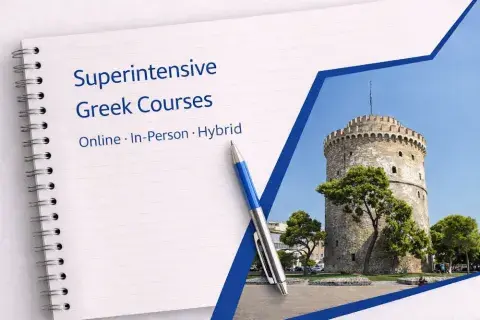
| Superintensive Greek Courses | 3 months | 10 hours/week | 120 | Accelerated progression |
| Online Greek Courses (Live) | 8 months | 4 hours/week | 128 | Full CEFR alignment |
| Private Greek Lessons | Flexible | Custom | Custom | Goal-specific |
| Business & Professional Greek | Flexible | Custom | Custom | Workplace Greek |
| Survival Greek | 2 months | 2.5h/week | 8 sessions | Functional A1–A2 |
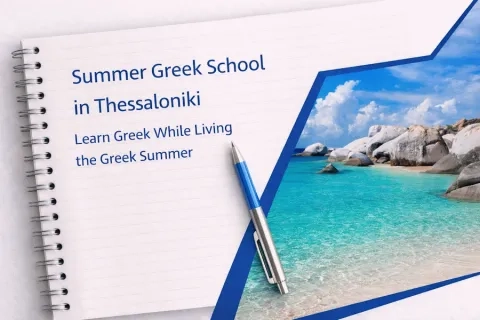
| Seasonal Courses | 4 weeks | 15h/week | 60 | ~1 CEFR level / cycle |
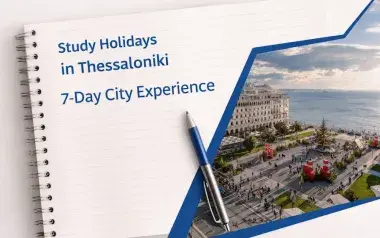
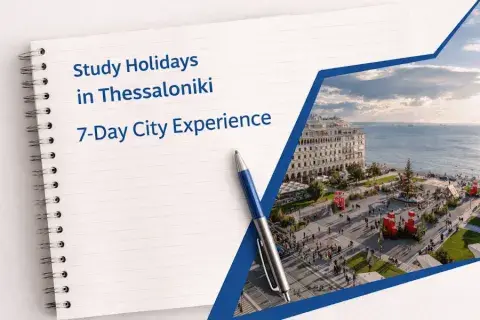
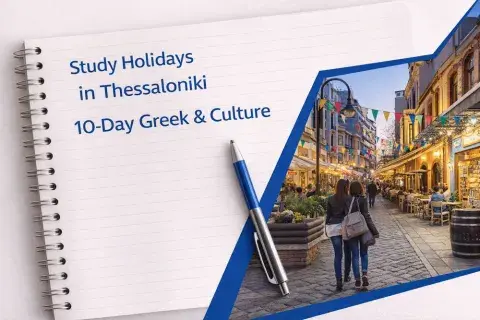
| Study Holidays (7–10 days) | 7–10 days | Structured daily | 35–65 | Immersion-based |
This ecosystem allows different learner profiles to choose a progression model instead of a generic course.
CEFR Progression Logic (A1–C2)
Greek language courses in Thessaloniki typically align with the CEFR scale:
-
A1 – Basic user (survival communication)
-
A2 – Elementary interaction
-
B1 – Independent user
-
B2 – Upper-intermediate operational fluency
-
C1 – Advanced academic proficiency
-
C2 – Mastery level
Structured programs integrate development in:
-
Listening
-
Reading
-
Speaking
-
Writing
-
Language Awareness
This is not conversational improvisation. It is structured language development.
Intensive vs Superintensive — Strategic Acceleration
Greek language courses in Thessaloniki differ significantly depending on intensity level.
Greek language courses in Thessaloniki follow structured CEFR progression (A1–C2), ensuring measurable language development rather than casual conversational exposure.
Every serious program must answer three academic questions:
-
How many hours?
-
At what weekly intensity?
-
What CEFR outcome?
Below is the structured ecosystem model.
| Parameter | Intensive | Superintensive |
|---|---|---|
| Duration | 8 months | 3 months |
| Weekly Hours | 4 | 10 |
| Total Hours | 128 | 120 |
| Pace | Gradual | Compressed |
| Ideal For | Working professionals | Relocation / urgent goals |
Who Should Choose Which Model?
Choose Intensive if:
-
You work or study simultaneously
-
You prefer gradual reinforcement
-
You aim for long-term certification
Choose Superintensive if:
-
You plan relocation
-
You need rapid functional fluency
-
You are preparing for certification under time pressure
Immersion and Experiential Learning in Greek Language Courses in Thessaloniki
Greek language courses in Thessaloniki can significantly enhance communicative development when structured classroom instruction is combined with consistent real-world exposure to the language.
Immersion on its own does not guarantee fluency. However, when it is pedagogically integrated with systematic grammar instruction, guided practice, and corrective feedback, it reinforces acquisition through repetition in authentic contexts.
In this respect, Thessaloniki offers a balanced urban environment where daily interaction in Greek becomes both accessible and manageable for international learners.
Why Thessaloniki Functions as a Linguistic Accelerator
Thessaloniki is a mid-sized, student-driven, socially interactive city. This creates a controlled immersion environment.
Thessaloniki provides a balanced immersion environment. It is large enough to generate constant authentic language exposure, yet compact enough to remain socially accessible and navigable.
Unlike larger capitals where learners can isolate themselves in English-speaking environments, Thessaloniki encourages daily interaction in Greek through:
-
Public transportation
-
Local markets and cafés
-
Municipal services
-
University-driven social spaces
-
Cultural and artistic events
The city naturally creates distributed language exposure throughout the day. This repeated contact reinforces classroom learning.
Experiential Learning (Βιωματική Μάθηση)
Experiential learning is the structured application of classroom knowledge in authentic communicative contexts. It does not replace grammar instruction; it operationalizes it through real use and guided reflection.
In effective Greek language courses in Thessaloniki, experiential learning functions as a controlled “transfer layer” between what learners know (rules) and what they can do (communication). The model typically follows a dual-phase structure:
Dual-Phase Structure
Morning Session
Focused instruction in grammar, syntax, pronunciation, and controlled conversation—designed to build accuracy and stable language patterns.
Applied Block
Real-world implementation under guided supervision or structured reflection—designed to convert “knowing” into “performing” in live conditions.
What the Applied Block Can Include
Structured experiential components may include:
-
Guided marketplace interaction tasks
-
Administrative language simulations (forms, appointments, inquiries)
-
Cultural workshop discussions
-
Real-time negotiation exercises
-
City-based communicative missions
Why This Works
This layered system supports durable acquisition by combining:
-
Declarative knowledge (rules and structures)
-
Procedural activation (actual use in context)
-
Corrective feedback (refinement for accuracy and naturalness)
Cognitive science supports the idea that grammar becomes more retrievable when it’s repeatedly activated in meaningful, contextual tasks—especially when feedback is immediate and the learner reflects on what worked and what didn’t.
The Core Principle
Experiential learning means:
You do not simulate language. You use it.
At Philoxenia, this is not “random conversation.” It is integrated into structured modules where grammar and vocabulary are introduced with intent, then activated through real tasks designed to produce measurable communicative outcomes.
Does Immersion Really Accelerate Fluency?
Immersion accelerates fluency only when three conditions are met:
-
Structured grammatical foundation
-
Repetition frequency
-
Feedback correction
Without structure, immersion leads to fossilized mistakes.
With structure, immersion becomes multiplicative.
In our programs, we have observed that learners who combine:
-
10+ hours/week structured study
-
Daily urban interaction
-
Weekly correction sessions
progress significantly faster in speaking confidence than those studying remotely only.
This is not anecdotal optimism.
It is pattern-based observation.
Classroom-Only vs Integrated Immersion Model
| Model | Primary Strength | Primary Limitation |
|---|---|---|
| Classroom-Only | Strong structural accuracy | Limited spontaneous activation |
| Immersion-Only | Authentic exposure | Lack of systematic correction |
| Integrated Model | Balanced structure and activation | Requires coordinated design |
Greek language courses in Thessaloniki that integrate both classroom precision and urban immersion outperform isolated models in communicative development.
Seasonal & Study Holiday Immersion Impact
Short-term immersion programs operate on a different mechanism than long-term academic cycles. They are designed as high-density exposure accelerators: concentrated input, frequent output, and rapid contextual feedback. These formats do not replace a full CEFR cycle; they act as catalysts that accelerate existing learning.
Study Holidays (7–10 days)
-
35–65 structured hours
-
High-density daily exposure with guided interaction
-
Cultural contextualization that anchors vocabulary and pragmatics (how language is actually used)
This structure creates a fast ‘entry into the language environment’: rhythm, reduced speaking inhibition, and quicker everyday interaction reflexes
Seasonal Courses (4 weeks)
-
60 instructional hours
-
Approx. one CEFR progression per cycle (entry level and consistency dependent)
-
Mon–Thu: core instruction (grammar, structure, controlled practice)
-
Fri: applied experiential learning (guided real-world activation)
Bu model, sınıf içi doğruluğu (accuracy) sahadaki kullanım (fluency + appropriateness) ile eşleştirerek öğrenmeyi kalıcı hale getirir.
Psychological Acceleration Factors
Living in the language reduces:
-
Performance anxiety
-
Translation dependency
-
Passive vocabulary stagnation
When learners must order, ask, respond daily, cognitive barriers collapse faster.
The city becomes a rehearsal stage.
Greek language courses in Thessaloniki therefore operate on two tracks:
-
Academic CEFR progression
-
Applied immersion activation
The strategic power lies in their integration.
Certification Pathway, Strategic Fit & Decision Framework
Greek language courses in Thessaloniki are most effective when they are clearly aligned with official certification standards and designed around the learner’s timeline, objectives, and capacity for study intensity.
Choosing a Greek course is not only a question of weekly hours. It is a strategic decision based on goals, timeframe, and the desired CEFR outcome.
This section clarifies three essential components:
-
Official certification alignment
-
Program selection logic
-
Strategic differentiation (ecosystem vs standalone courses)
Official Certification Pathway (Certificate of Attainment in Greek)
CEFR-aligned Greek language courses in Thessaloniki can support preparation for the official Certificate of Attainment in Greek, administered by the Centre for the Greek Language under the supervision of the Hellenic Ministry of Education.
Certification-focused learning requires more than conversational confidence. A successful pathway is built on structured progression across all core competencies:
-
Listening
-
Reading
-
Speaking
-
Writing
-
Language awareness
A CEFR-based curriculum matters because it creates continuity between:
course structure → measurable level outcomes → exam readiness → official certification.
A practical overview of how certification goals typically align with learner profiles:
| CEFR Level | Typical Learner Goal | Certification Context |
|---|---|---|
| A1–A2 | Everyday independence and basic interaction | Foundation stage for formal progression |
| B1 | Functional autonomy for work and integration | Common milestone for long-term residents |
| B2 | Professional and academic readiness | Strong target for career-oriented learners |
| C1–C2 | Advanced fluency and high-precision usage | Full mastery and high-stakes certification goals |
When certification is a priority, program choice should be driven by time horizon and intensity capacity, not by course labels alone.
Program Selection Logic: Choosing the Right Format
Greek language courses in Thessaloniki vary by intensity, duration, and learner purpose. A clear selection framework prevents mismatched expectations and improves outcomes.
Choose an Intensive pathway if you:
-
Want steady, long-term CEFR progression
-
Need a sustainable schedule alongside work or university
-
Prefer distributed reinforcement and long-term retention
-
Plan for structured advancement toward certification over time
Choose a Superintensive pathway if you:
-
Have a short time window and need accelerated progress
-
Are relocating to Greece and require rapid communicative independence
-
Can sustain high weekly exposure and intensive study rhythm
-
Need faster integration for professional or practical reasons
Choose Online Greek (Live) if you:
-
Are outside Greece or need location-independent study
-
Want structured CEFR progression with schedule stability
-
Prefer remote learning while maintaining curriculum continuity
Choose Survival Greek if you:
-
Recently moved to Thessaloniki and need immediate functional language
-
Prioritize everyday communication (services, shopping, city routines)
-
Want a practical entry pathway before longer-term progression
Choose Study Holidays / Seasonal Programs if you:
-
Combine travel with structured learning
-
Want short-term immersion to activate speaking confidence
-
Prefer intensive cycles that support rapid communicative development
The best choice is not “the most intensive” option. It is the option that matches your goals with the correct learning rhythm.
Strategic Differentiation: Academic Ecosystem vs Standalone Courses
Greek language courses in Thessaloniki are not all built on the same educational architecture. A key differentiator is whether the offering functions as a standalone set of lessons or as part of a structured, scalable learning ecosystem.
Standalone course model typically offers:
-
Limited visibility of CEFR progression
-
Less continuity between formats (short-term → long-term)
-
Less integration between immersion exposure and structured outcomes
Structured ecosystem model typically provides:
-
A clear CEFR pathway (A1–C2)
-
Defined hour allocation and intensity formats
-
Certification alignment when required
-
Format flexibility (online, in-person, hybrid)
-
Pedagogical integration of immersion and experiential learning
From an evaluation standpoint, ecosystem structure improves:
-
Predictability of outcomes
-
Learner retention and consistency
-
Decision clarity for prospective students
It also strengthens transparency—one of the most important quality signals for both users and search engines.
Decision Matrix (Quick Fit)
| Primary Goal | Recommended Pathway |
|---|---|
| Long-term CEFR progression and certification planning | Intensive track |
| Rapid progress for relocation or urgent goals | Superintensive track |
| Remote study with structured progression | Online Greek (Live) |
| Immediate everyday communication in Thessaloniki | Survival Greek |
| Short-term immersion activation | Study Holidays / Seasonal cycles |
This matrix is designed as a starting point. Final placement and program fit should always be confirmed through level assessment and goal mapping.
Summary
Greek language courses in Thessaloniki should be evaluated as structured learning pathways—defined by CEFR outcomes, intensity capacity, and certification objectives—rather than as generic class options.
A strong decision framework prioritizes:
-
CEFR-aligned progression
-
Program fit based on timeline and intensity
-
A structured ecosystem that integrates experiential learning and measurable outcomes
For registration and current availability, contact Philoxenia Greek Language School (City Center) at Egnatia 45, Thessaloniki. Tel: 2310 53 5444 | Mobile: 694 723 8850 | Email: info@greeklanguageschool.com
| Website: www.greeklanguageschool.com
. Share your current level (or request a placement check), your preferred schedule, your timeline, and whether you are targeting the Certificate of Attainment in Greek so the team can confirm the best-fit pathway and finalize enrollment.