
Table of Contents
- What Does “Experiential Greek Learning” Mean?
- Thessaloniki as a Living Language Laboratory
- How This Connects to the Survival Greek Course (2 Months)
- How It Extends the Study Holidays Programs
- Integration with Intensive and Long-Term Greek Programs
- Structured Immersion vs. Casual Exposure
- Greek Immersion in Thessaloniki: Does It Really Accelerate Fluency?
- Alignment with Official Certification Pathways
- The Pedagogical Philosophy Behind the Workshop
- Who Is This Model For?
- Greek as a Living Experience
Greek language learning at Philoxenia is structured as experiential immersion in Thessaloniki, where classroom instruction and real-world interaction function as a unified pedagogical system rather than separate activities. The Experiential Greek Workshop is not a standalone product. It is the methodological core that connects our Survival Greek Course, Study Holidays, Intensive Programs, and Long-Term CEFR pathways into one coherent immersion-based model.
This page explains how that model works.
What Does “Experiential Greek Learning” Mean?
Experiential Greek learning means structured, guided language activation in real-life contexts, aligned with CEFR progression and reinforced through reflection, analysis, and communicative practice.
In many schools, immersion is interpreted as exposure: students hear Greek, walk around the city, and “pick it up.” We take a different approach.
At Philoxenia Greek Language School, experiential learning (βιωματική μάθηση) is:
-
Task-based and goal-oriented
-
Linked to specific CEFR descriptors (A1–C2)
-
Supported by structured grammar progression
-
Followed by guided reflection and correction
In practical terms, this means students do not simply “visit a market.” They complete communicative missions designed to activate vocabulary, sentence structure, and pragmatic language use relevant to their level.
Language becomes a tool in motion.
Thessaloniki as a Living Language Laboratory
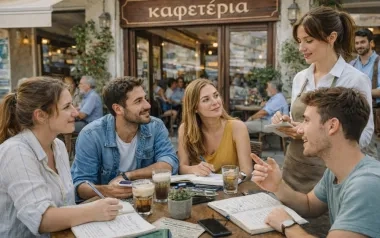
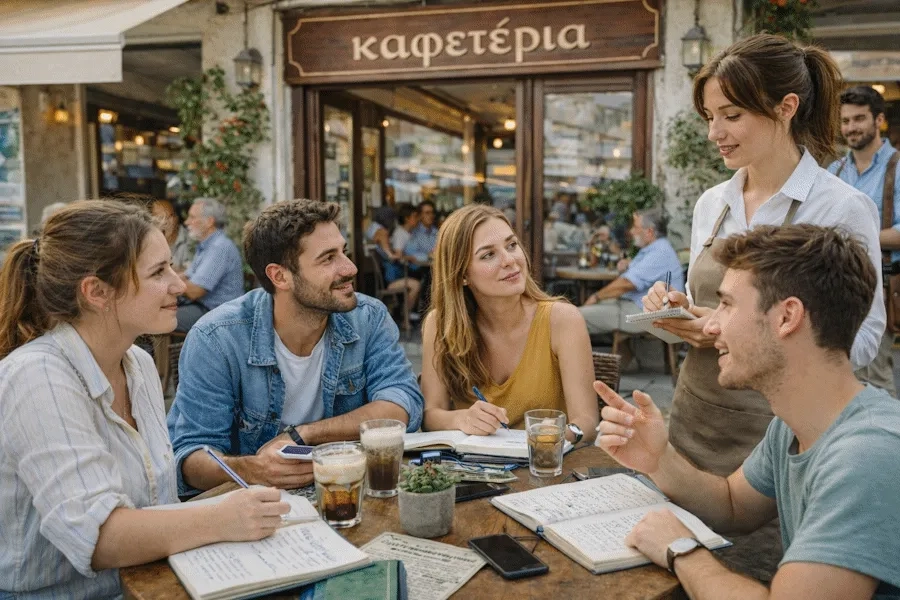
Thessaloniki functions as an extended classroom where linguistic interaction unfolds naturally in cafés, markets, public transport, museums, and waterfront spaces.
This city offers a rare balance:
-
Large enough to provide linguistic diversity
-
Compact enough to feel human and navigable
-
Academic enough to sustain intellectual exchange
-
Social enough to foster spontaneous communication
Our experiential workshop model integrates urban interaction into the curriculum in structured cycles:
-
Pre-task preparation in class
-
Guided real-world interaction
-
Post-task linguistic analysis
Students practice ordering food, asking for clarification, expressing opinions, negotiating meaning, and managing social exchanges — not randomly, but in alignment with communicative competence descriptors defined by the Common European Framework of Reference (CEFR).
The city becomes a pedagogical instrument.
How This Connects to the Survival Greek Course (2 Months)
The Survival Greek Course (2 Months) — Practical Greek for Everyday Life in Thessaloniki is the clearest operational example of our experiential framework.
This program is designed for learners who:
-
Live in Thessaloniki
-
Relocate for work
-
Study at local institutions
-
Need immediate communicative autonomy
Within this course:
-
Everyday vocabulary is activated through real-life tasks
-
Functional grammar is practiced in authentic settings
-
Listening comprehension is trained through real ambient exposure
Rather than translating mentally, students begin to respond directly in Greek. Over time, reaction replaces hesitation.
The experiential workshop model ensures that practical Greek is not memorized — it is lived.
How It Extends the Study Holidays Programs
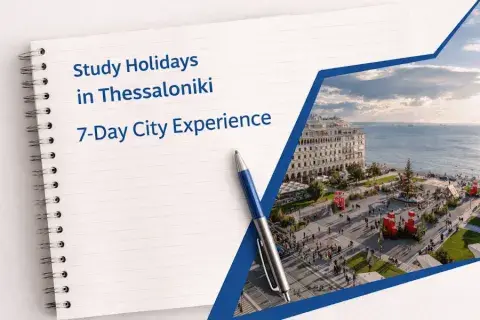
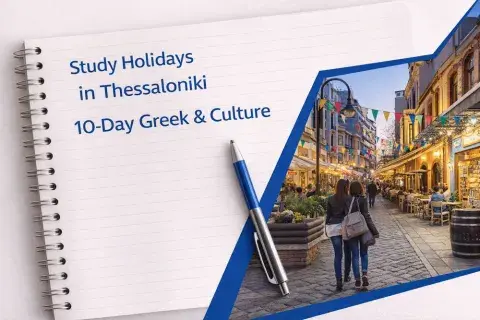
Our immersive methodology also structures the following short-term programs:
These are not tourism packages with language lessons attached. They are intensive experiential cycles compressed into shorter timeframes.
Morning sessions focus on:
-
Grammar clarity
-
Pronunciation accuracy
-
Structured vocabulary expansion
Afternoon activities are not passive excursions. They are pedagogically designed language laboratories.
Examples include:
-
Museum visits with communicative objectives
-
Guided culinary workshops with vocabulary activation
-
Historical walks linked to narrative practice
The experiential workshop framework ensures that cultural contact becomes linguistic growth.
Integration with Intensive and Long-Term Greek Programs
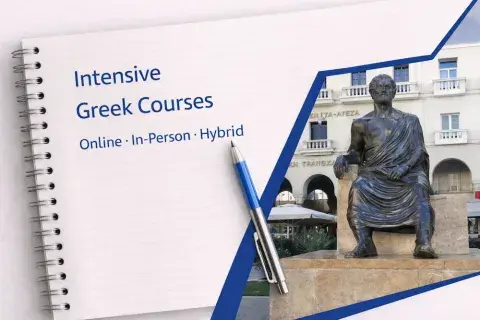
Experiential learning is not limited to short-term formats. It is embedded in:
In longer academic pathways, experiential workshops operate as reinforcement cycles.
For example:
-
At B1 level, learners complete structured debate simulations in real contexts.
-
At B2 level, they conduct guided interviews.
-
At C1 level, they analyze discourse patterns in authentic public speech.
Even exam preparation integrates experiential tasks, ensuring that linguistic competence remains communicative rather than mechanical.
Structured Immersion vs. Casual Exposure
Immersion without structure leads to frustration. Structure without immersion leads to rigidity.
Our model balances both.
| Casual Exposure | Structured Experiential Model |
|---|---|
| Unplanned interaction | Guided communicative missions |
| Vocabulary without consolidation | Pre-task & post-task integration |
| Emotional confidence only | Emotional + structural competence |
| Cultural contact | Cultural + linguistic mapping |
This balance differentiates an immersion-based methodology from informal language exposure.
The goal is not to “survive Greek.”
The goal is to internalize Greek as a communicative system.
Alignment with Official Certification Pathways
Experiential learning does not replace academic rigor. It strengthens it.
All programs align with the Certificate of Attainment in Greek, administered by the Centre for the Greek Language.
This ensures:
-
Listening competence is real, not rehearsed
-
Writing skills reflect authentic communicative ability
-
Speaking performance is grounded in real interaction
-
Language awareness develops analytically
Students preparing for official exams benefit from experiential reinforcement, because authentic interaction reduces exam anxiety and increases spontaneous production capacity.
Competence becomes embodied, not memorized.
The Pedagogical Philosophy Behind the Workshop
Our methodology is rooted in three principles:
-
Language is relational.
-
Communication precedes perfection.
-
Structure enables spontaneity.
At Philoxenia, teachers function as cultural mediators and communicative guides. They do not merely deliver grammar rules. They facilitate linguistic participation.
Students are encouraged to:
-
Experiment with language
-
Make mistakes constructively
-
Reflect on usage
-
Develop personal voice
Learning Greek becomes an act of engagement rather than performance.
Who Is This Model For?
The experiential Greek workshop approach is particularly effective for:
-
Digital nomads relocating to Greece
-
Erasmus students
-
Professionals entering the Greek market
-
Heritage learners reconnecting with family roots
-
Long-term residents seeking integration
It supports both:
-
Short-term communicative needs
-
Long-term academic progression
Because immersion without reflection is chaotic.
Reflection without immersion is sterile.
Our model integrates both.
Greek as a Living Experience
Greek is not merely an academic subject. It is a living cultural continuum.
To learn Greek in Thessaloniki means entering a linguistic ecosystem shaped by history, commerce, hospitality, migration, and creativity.
The Experiential Greek Workshop model reflects that reality.
Language moves.
Culture breathes.
Structure supports spontaneity.
And Thessaloniki remains the stage where all these dimensions converge.
If you are exploring Greek language programs in Thessaloniki, whether through Survival Greek, Study Holidays, Intensive Courses, or Long-Term CEFR pathways, the experiential framework is already integrated.
You do not just study Greek here.
You participate in it.