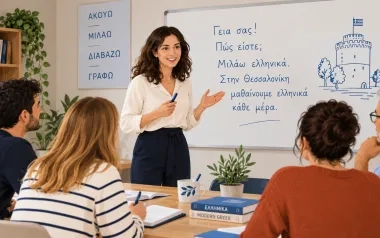



Living and working remotely in Thessaloniki is easier when you can use practical Greek. You do not need perfect fluency to start asking questions, confirming appointments and navigating local services. At Philoxenia Greek Language School, we connect structured learning with useful communication in everyday city life.
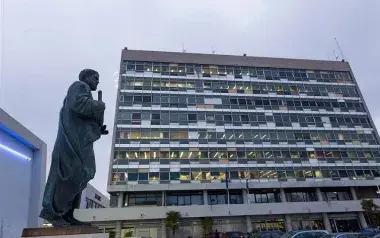
This guide is for expats, international residents and digital nomads comparing Greek courses in Thessaloniki, from short practical programmes to long-term CEFR study. Our school is located at Egnatia 45 in the city centre.
Greek for everyday life in Thessaloniki
For newcomers, practical communication often starts with a small set of high-value skills: introducing yourself, understanding numbers and times, making a polite request, reading a notice and asking someone to repeat information. These are realistic starting goals rather than promises of instant fluency.
- At cafés and shops: ask for items, prices, receipts and quantities.
- At appointments: give names and dates, confirm a time or ask for clarification.
- In your neighbourhood: read opening hours and signs and ask for directions.
- At work: distinguish informal conversations from more formal messages and requests.
Daily exposure can support your learning, but guided teaching and opportunities to receive feedback help turn repeated phrases into transferable skills. This practical approach is consistent with the Council of Europe’s action-oriented CEFR approach.
Choose a Greek course that fits your stay and working week
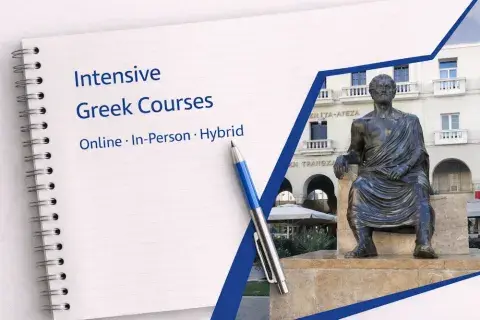
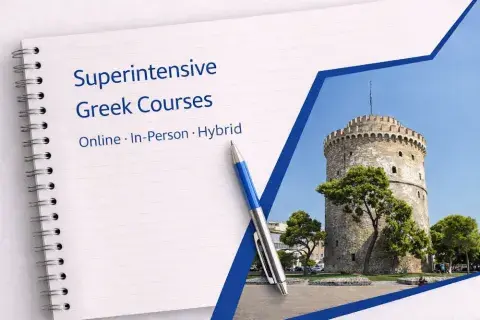
Online study is a mode of participation within our relevant Intensive and Superintensive group courses, not a separately priced third long-term programme. Academic teaching hours are 50 minutes. Published intake periods do not establish that a particular group or lesson time is already confirmed.
| Programme | Duration and teaching load | 2027 tuition | Best suited to |
|---|---|---|---|
| Survival Greek | 2 months; 8 sessions; 20 academic hours total; in person | €100 total (2 × €50) | Practical everyday communication; not a full CEFR level |
| Intensive Greek Courses | 8 months; 4 academic hours/week; 128 total; two CEFR curriculum levels | A1–A2: €80/month; B1–C2: €90/month | Steady study alongside work |
| Superintensive Greek Courses | 3 months; 10 academic hours/week; 120 total; two CEFR curriculum levels | A1–A2: €210/month; B1–C2: €250/month | Students able to commit to a demanding weekday schedule |
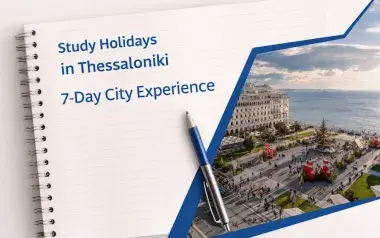
| 7-Day Study Holidays | 7 days; about 35 structured learning and city-activity hours (not 35 academic teaching hours) | €400 | Short stay combining guided Greek and city experience |
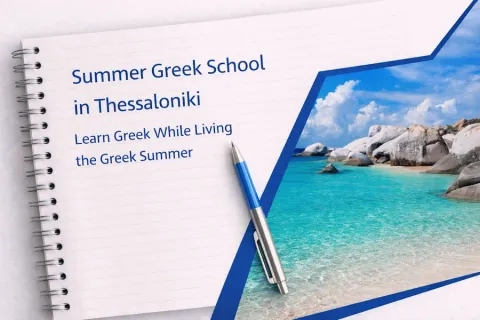
| Seasonal Intensive/Summer Greek Course | 4 weeks; 60 academic hours; one CEFR level of curriculum covered; in person | €600 | Visitors planning four weeks of structured study |
Each two-level Intensive or Superintensive cycle refers to curriculum coverage, not a guaranteed individual CEFR result or exam pass. If you have irregular work hours, we can discuss separately arranged private lessons; the standard rate is €30 per 50-minute academic lesson, subject to teacher availability. For work-related goals, see Business & Professional Greek.
What 2027 dates should you plan around?
Our 2027 published intakes include Intensive (February and October entry options), Superintensive (winter, spring and autumn), Survival Greek (spring, early summer and autumn), and four 7-day Study Holidays groups in April, June, July and October. Seasonal four-week courses are planned for winter, spring and autumn, with a separate July summer course. Consult each programme page for exact dates; availability and group meeting times require confirmation.
Learning Greek while working across time zones
Remote work may make study time unpredictable, so choose between the steady weekly rhythm of Intensive and the higher time commitment of Superintensive before enrolling. Our group classes do not offer an unrestricted choice of lesson times. If you are moving away from Thessaloniki, ask whether online attendance is possible in your particular group.
For short daily practice, choose one communicative task: confirm a reservation, ask a shop assistant for an item, read an announcement or prepare two sentences for a call. Revisit the words afterwards and bring unclear points to class. Our registered students also have free access to the Babylonia Language Lab for supplementary study outside lessons.
How our experiential approach supports practical Greek
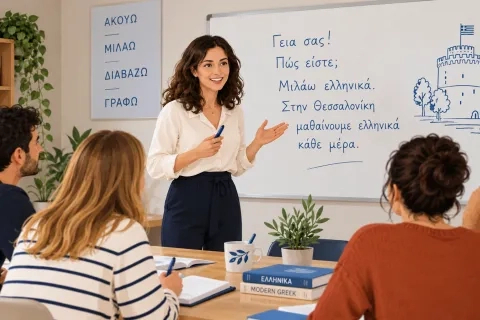
Learning activities can connect language work with real situations in the city. The exact balance of classroom and guided experiences depends on the programme: our seven-day Study Holidays and four-week onsite courses have defined experiential components, while our regular group courses focus on their published teaching curricula. We do not promise excursions or outdoor lessons in every group.
The British Council describes task-based learning as communication centred on completing a meaningful task, followed by discussion of the language used. This is a useful educational principle when planning everyday practice. See its explanation of task-based learning.
Language goals are different from immigration requirements
Greek is valuable for building day-to-day independence, professional communication and social participation. However, we do not treat a Digital Nomad Visa or Golden Visa as evidence that a specific B1 or B2 certificate is required. Rules for residence, employment and visas belong to the competent authorities. If an academic or professional body asks you for official Greek proficiency, confirm the level and accepted certificate directly with that body.
Five practical Greek routines for newcomers
- Practise one polite greeting and request before entering a café.
- Read local opening hours and identify dates, days and numbers.
- Ask for a repetition or slower speech when you do not understand.
- Record useful expressions after each appointment or errand.
- Review mistakes briefly and ask your teacher how to improve them.
Related learning resources
Life in Thessaloniki · Student Questions
Greek for Expats and Digital Nomads: Practical Questions
Answers from Philoxenia about learning Greek alongside remote work and using it in everyday life in Thessaloniki.
Can I learn Greek fast if I work full time remotely?
Yes, you can make steady progress alongside remote work, but the right course depends on how many scheduled class hours you can attend consistently.
Our Intensive programme has four academic teaching hours per week, while Superintensive requires ten. We can discuss an available group or teacher availability for online private lessons; class times are not freely selectable or guaranteed.
What’s the difference between Survival Greek and B2 Greek?
Survival Greek focuses on practical everyday communication; B2 is an upper-intermediate CEFR proficiency level requiring much broader skills.
Our in-person Survival Greek course consists of eight sessions and 20 academic hours. It does not cover or certify a full CEFR level. For structured progression towards B2, explore our longer-term Intensive or Superintensive courses.
Do I need grammar if my goal is only speaking?
Yes. A practical understanding of basic Greek grammar helps you ask clear questions, describe situations and make yourself understood.
We connect grammar to useful exchanges such as arranging a delivery, explaining an address or making an appointment, rather than treating grammar as an end in itself.
Is Thessaloniki good for language immersion?
Yes. Thessaloniki offers opportunities to hear and use Greek in markets, cafés, local services and everyday neighbourhood interactions.
Living in the city does not automatically produce fluency. We recommend combining regular learning, manageable real-life speaking tasks and feedback.
Can I continue my lessons online if I leave Thessaloniki?
Online participation may be possible through an available Intensive or Superintensive group, or through separately arranged private lessons.
Please check with us before relocating or changing your attendance mode: group arrangements and teacher availability must be confirmed, and we cannot promise an automatic transfer or unchanged timetable.
Which format fits a short stay of about one week?
Our seven-day Study Holidays City Experience is the relevant short-stay option for learning Greek alongside structured cultural activities in Thessaloniki.
The 2027 programme is scheduled in specific seasonal windows, not on demand throughout the year. It offers about 35 structured learning and activity hours rather than a full CEFR level; ask us whether a suitable group is being formed.
Can I manage everyday life in Thessaloniki before I speak Greek?
Many newcomers can handle some situations in English, but knowing a little Greek makes everyday requests and follow-up questions easier.
We suggest starting with numbers, addresses, dates, polite requests and clarification phrases for shops, deliveries and appointments. For unfamiliar official procedures, ask the relevant authority for accurate instructions rather than relying solely on language practice.
What if someone answers me in English when I try speaking Greek?
You can politely ask to continue in Greek when the other person has time, but respect their preference if the interaction is busy or urgent.
Try a short phrase such as “Μπορούμε να μιλήσουμε λίγο ελληνικά;” (“Could we speak a little Greek?”). Our advice is to practise in appropriate low-pressure moments, not to turn every service encounter into a lesson.
How can I make local connections if I work remotely and rarely meet Greek colleagues?
Choose recurring activities outside work where you have a reason to interact with people, rather than relying only on chance conversations.
A regular local class, hobby group or neighbourhood routine creates repeated opportunities to listen, ask simple questions and get comfortable with social language. We can help you practise useful expressions in lessons, but cannot guarantee social introductions or networking outcomes.
What Greek should I learn first for appointments, deliveries and service calls?
Start with your name and address, numbers, dates, availability, and a few phrases for asking someone to repeat or confirm information.
Useful examples include “Θα ήθελα να κλείσω ραντεβού” (“I would like to book an appointment”), “Μπορείτε να το επαναλάβετε;” (“Could you repeat that?”) and “Η διεύθυνσή μου είναι…” (“My address is…”). These are examples for communication, not official administrative guidance.
Contact Philoxenia Greek Language School
Egnatia 45, Thessaloniki (City Centre) · Tel: 2310 53 5444 · Mobile: 694 723 8850 · info@greeklanguageschool.com