




Table of Contents
- Superintensive Greek Courses – Online, In-Person & Hybrid
- Who Is a Three-Month Superintensive Greek Course For?
- How a Three-Month Superintensive Greek Course Works
- What Happens During Daily Superintensive Greek Lessons?
- How to Manage Learning Greek Five Days a Week
- How We Support Language Development During an Accelerated Course
- CEFR Levels, Starting Points and Placement
- Learning Greek in Thessaloniki or Attending Live Online
- Registration, Tuition and Next Steps
- 🚀 Superintensive Greek Courses — 2027 Three-Month Tracks (2 CEFR Levels)
- Superintensive Greek Courses – Frequently Asked Questions
Superintensive Greek Courses – Online, In-Person & Hybrid
A fast-track 3-month Greek program with daily classes, designed to support progress through two CEFR levels.
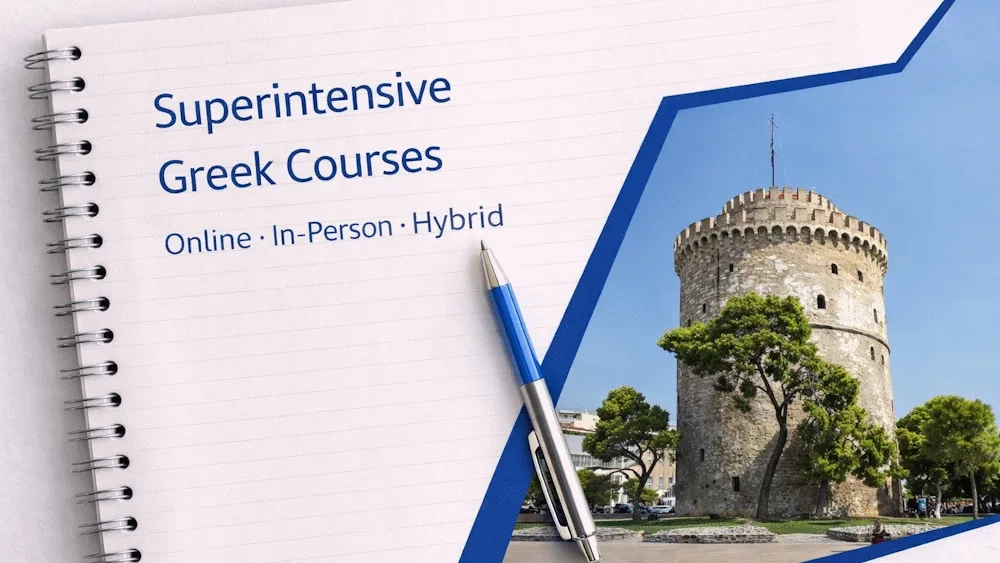
The Superintensive Greek Courses at Philoxenia Greek Language School provide a concentrated three-month pathway for adults who can commit to Greek lessons on five weekdays. By keeping new material and guided practice close together, the programme helps learners build continuity across speaking, listening, reading and writing. The complete cycle covers the curriculum for two consecutive CEFR levels; individual attainment and examination results depend on each learner's starting point, participation and independent practice.
In-person groups meet in Thessaloniki, while live online and hybrid attendance may be available within a suitable group. Published intake periods indicate planned course windows, not confirmation that every level or attendance format will run. Register your interest so we can review your level and the appropriate available group.
Who Is a Three-Month Superintensive Greek Course For?
This format is intended for learners who need a focused study period and can attend regularly throughout the working week. It may suit people preparing to relocate to Greece, international students, professionals who need Greek in everyday or workplace situations, and learners who prefer frequent guided practice rather than a longer weekly timetable.
More frequent lessons do not mean that the programme is automatically the best option for everyone. Students with a full-time job, an unpredictable schedule or limited time for revision should consider whether they can maintain daily attendance. Our eight-month Intensive Greek Courses provide another route through two consecutive CEFR curriculum levels at a different weekly pace.
How a Three-Month Superintensive Greek Course Works
From the First Weeks to the Final Course Stage
At the beginning of a course cycle, lessons establish or consolidate the language required for the group’s starting level. Subsequent work builds on those foundations through increasingly varied listening, reading, speaking and writing tasks. Teachers revisit important patterns as new structures are introduced, making regular attendance and revision especially relevant in a course that meets on consecutive weekdays.
Covering Two Consecutive CEFR Levels
The full three-month curriculum addresses two consecutive levels within one track: A1–A2, B1–B2 or C1–C2. Learning objectives and materials differ by track. For example, a beginner works towards handling familiar everyday exchanges, whereas a B1–B2 learner works with more extended interaction, explanations and increasingly complex texts.
Curriculum Coverage Is Not a Guaranteed CEFR Result
Completing the planned syllabus is different from demonstrating a particular level of independent language proficiency. Outcomes depend on previous knowledge, consistency, opportunities to use Greek outside class and progress in individual skills. Official Greek language certification requires the relevant examination through an authorised body; it is not automatically awarded by course participation.
What Happens During Daily Superintensive Greek Lessons?
Introducing Grammar Through Communicative Tasks
Our teaching approach combines structured explanations with contextual use. A lesson may introduce a grammatical pattern through an everyday exchange, explore how it works, and then reinforce it through supported dialogue, short writing tasks or collaborative activities. These are illustrations of the learning approach rather than a fixed activity sequence promised for every class.
Developing Speaking, Listening, Reading and Writing
Students work with language for realistic purposes, such as requesting information, describing experiences, expressing preferences or interpreting written messages at a suitable CEFR level. Listening and speaking activities create opportunities to respond without preparing every sentence in advance; reading and writing practice help learners notice structure, accuracy and register. Teacher feedback supports improvement without implying identical progress for every participant.
How to Manage Learning Greek Five Days a Week
Reviewing New Material Without Falling Behind
In a high-frequency course, short and consistent review matters. Learners can revisit the day’s vocabulary, practise a few examples aloud, listen again to level-appropriate material and note which structures need clarification. Asking about an uncertainty promptly is often more useful than allowing several lessons of new material to accumulate on top of it.
Balancing Daily Classes, Independent Study and Rest
Daily attendance requires time and attention beyond the lessons themselves. A manageable routine allows for focused revision while leaving space to rest and process new information. If the pace becomes difficult, students should tell their teacher or our academic team early so that the learning difficulties and possible support options can be discussed; additional private teaching, if requested, is arranged and charged separately and is subject to teacher availability.
Babylonia Language Lab – Free Digital Learning Support
All enrolled Philoxenia students receive free access to the Babylonia Language Lab, our supplementary digital learning resource. Its self-paced practice can help students revisit vocabulary and grammar and reinforce reading and listening work between daily lessons. It supports, rather than replaces, participation in the live course. Required textbooks are purchased separately.
How We Support Language Development During an Accelerated Course
Understanding Uneven Progress Across Language Skills
Students do not always develop speaking, listening, reading and writing at the same rate. Someone may understand a grammatical explanation yet hesitate during conversation, or read confidently while finding natural-speed speech challenging. Sharing these difficulties with the teacher helps make feedback more focused and can guide realistic independent practice.
Using CEFR-Based Tasks to Review Progress
Progress can be discussed through practical abilities: understanding a suitable message, maintaining a level-appropriate exchange, explaining an opinion or writing for a familiar purpose. CEFR descriptors provide a useful reference for such tasks, while teacher feedback helps identify strengths and areas to revisit. They do not constitute a promise of a particular examination result or an invented school-wide scoring system.
CEFR Levels, Starting Points and Placement
We follow the Common European Framework of Reference for Languages, from A1 beginner to C2 proficiency. A1–A2 learning centres on basic and routine communication; B1–B2 expands independent discussion and comprehension of more complex information; C1–C2 develops greater precision, flexibility and control across contexts. The appropriate track depends on the learner’s actual starting knowledge and on group availability.
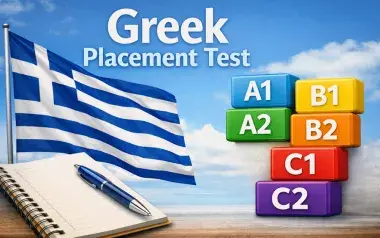
Complete A1 beginners do not need a placement test automatically, even if they already know the alphabet or a few words. If you have studied Greek before, our Greek placement test can help us review which group is most suitable. Assessment supports a recommendation; it does not guarantee that a specific group will be available.
Learning Greek in Thessaloniki or Attending Live Online
In-person Superintensive Greek lessons take place in Thessaloniki. Students living in the city can practise expressions from class in everyday situations, for example when shopping, ordering food, asking for information or taking part in local conversations. These are opportunities to extend classroom learning; ordinary group attendance should not be confused with a separately organised city-activity programme.

Live online participation follows the teaching format of the relevant group rather than an independently scheduled online intake. Hybrid arrangements depend on the actual group organisation. We confirm group availability, attendance arrangements and precise class times before participation; we cannot assume that every advertised intake will have every level or delivery mode.
Registration, Tuition and Next Steps
Our Superintensive courses are offered within published winter, spring and autumn intake windows. The course facts and tuition table on this page show the applicable duration, teaching load, intake dates and fees. The 15% full prepayment discount is explained in the pricing section below; students can also use the stated monthly instalment option. The full three-month curriculum covers 120 academic teaching hours, with affected public-holiday classes rearranged where necessary.
You can submit your registration online or contact us about the available group for your level and preferred attendance mode. In-person enquiries may be made at Egnatia 45, near Venizelou metro station, Thessaloniki, or by telephone at 231 053 5444. After receiving your enquiry, we can advise you about placement, the group timetable and next steps. See the payment methods for payment information.
| Level | Sessions per Week | Duration (Months) | Total Hours | Levels / Certification |
|---|---|---|---|---|
| A1–A2 | 10 academic hours (5 sessions) | 3 | 120 | A1 · A2 |
| B1–B2 | 10 academic hours (5 sessions) | 3 | 120 | B1 · B2 |
| C1–C2 | 10 academic hours (5 sessions) | 3 | 120 | C1 · C2 |
🔁 Upon completion of the first course cycle, students may seamlessly continue to subsequent course levels, ensuring continuity in their learning path and progressive language development.
Superintensive Courses (5 sessions per week)
📅 Duration: 3 months
🕓 Frequency: 5 sessions per week × 2 academic hours
⏱ Total Instruction Time: 120 teaching hours
🏫 Attendance Mode: In-person, Online or Hybrid
🔗 Application Form: Register Now
💶 Tuition Fee: A1–A2 €210/month (€630 total); B1–C2 €250/month (€750 total).
💰 15% Prepayment Discount: A1–A2 €535; B1–C2 €637 when the full three-month tuition is paid in advance.
💳 Payment Options: View our Payment Methods for available payment options and instructions.
⚡ Superintensive Greek courses are designed for learners who aim to prepare more efficiently for examinations or achieve measurable progress within a shorter timeframe.
The increased course intensity ensures continuous exposure to the language, systematic practice, and accelerated development across all core language skills.
🚀 Superintensive Greek Courses — 2027 Three-Month Tracks (2 CEFR Levels)
2027 intake windows: Winter, Spring and Autumn
Each track: 3 months, typically covering 2 CEFR levels (fast-paced progression).
Option A (Autumn Fast-Track)
Start: 4 October 2027
End: 31 December 2027
Option B (Winter Fast-Track)
Start: 11 January 2027
End: 9 April 2027
Option C (Spring Fast-Track)
Start: 1 March 2027
End: 31 May 2027
Tuition & Payment Information
Tuition for the three-month Superintensive Greek Courses is €210 per month (€630 total) for A1–A2 and €250 per month (€750 total) for B1–B2 and C1–C2.
Students who pay the full three-month tuition in advance benefit from a 15% prepayment discount, with the final payable amounts rounded down to whole euros:
- A1–A2: €535 instead of €630
- B1–B2 and C1–C2: €637 instead of €750
Students may also pay the standard tuition in three monthly instalments. The prepayment discount applies only when the full three-month tuition is paid in advance.
Student questions
Superintensive Greek Courses – Frequently Asked Questions
Practical guidance on learning Greek at an accelerated pace, choosing the right course, joining a group and preparing for your next steps.
Is Greek difficult to learn for complete beginners?
Greek has a different alphabet and some unfamiliar grammar, but beginners can learn it systematically. The important first steps are connecting letters with sounds, using frequent phrases and practising short conversations. A structured A1 course begins with these foundations; knowing the alphabet beforehand is helpful but not a prerequisite.
Can I learn to speak Greek in three months?
You can develop and practise substantial speaking skills in three months, but fluency is not automatic. Philoxenia’s Superintensive syllabus covers two CEFR levels across its 120 teaching hours. How independently you speak at the end will also depend on your starting point, attendance, personal practice and the situations you need Greek for.
How does a Superintensive Greek course compare with a regular Intensive course?
The difference is the pace and frequency of learning, not simply the label. Superintensive study concentrates instruction into a shorter period and requires more frequent preparation and revision. Philoxenia’s longer Intensive Greek Course spreads its curriculum across a longer cycle. Choose based on your weekly availability, learning rhythm and goals.
Should I choose group Greek lessons or private lessons to learn faster?
A group provides regular interaction and shared speaking practice; private lessons offer more individual pacing and targeted correction. Neither is automatically faster for everyone. If you have uneven skills, unpredictable availability or a specific exam deadline, discuss whether a group, separately paid private lessons or a combination is appropriate.
How much Greek should I study outside class in an accelerated course?
Plan for frequent short review rather than relying only on classroom time. Revisiting vocabulary the same day, practising listening and using new structures in brief conversations will help you keep pace. The amount you need varies by level and previous experience, so ask your teacher to prioritise work that addresses your weakest skills.
Can I start learning Greek without knowing the alphabet?
Yes. Knowing the alphabet or a few expressions is not equivalent to completing A1, and a genuine beginner does not automatically need a placement test. Expect to spend some time practising Greek letters and sounds early on, since reading signs, messages and course materials soon becomes useful.
I studied Greek years ago. Do I need to start again from A1?
Not necessarily. Vocabulary, grammar, listening and speaking may have developed unevenly or faded at different rates. If you have studied Greek before, take the Greek placement test and explain which skills you find difficult, so the school can evaluate a suitable starting group.
What if I understand Greek grammar but cannot speak confidently?
This is a common imbalance. Tell the school about it when discussing placement, rather than choosing a level based on written grammar alone. Regular listening, short spontaneous responses and speaking practice can complement the group syllabus; individual support may be useful if the gap is substantial.
Can I join a Superintensive Greek group after classes have begun?
Possibly, if an appropriate group is still available and your Greek knowledge matches its current stage. You are not charged for group lessons that took place before you joined. If you need to catch up, separately paid private lessons may help you cover missed material before entering the group; admission is not automatic.
What happens if I miss several consecutive classes?
Contact Philoxenia as early as possible to review the material missed and whether you can continue at the group’s pace. Daily lessons build on previous work, so you may need independent revision or separately arranged private instruction. Do not assume that missed group classes are automatically repeated.
Can I take a daily Greek course while working full-time?
It depends on your working hours and capacity for consistent review. Daily attendance is only one part of an accelerated course: you also need time to process new grammar and vocabulary between meetings. Check the actual group timetable before committing; class times cannot be assumed from the advertised intake dates.
Are live online Greek lessons as effective as learning in person?
Both can support strong progress when lessons are interactive and attendance is consistent. Online classes remove travel time; being in Thessaloniki adds opportunities to practise Greek outside the classroom. Your learning habits and participation matter more than the format alone. Confirm the online group’s arrangements before choosing.
Can I change between online and in-person attendance during a course?
That may be possible in a group organised for hybrid attendance, but it is not guaranteed for every class. Ask Philoxenia about the arrangements for the specific group before planning travel or relying on day-to-day switching.
Will a Superintensive course prepare me for the Certificate of Attainment in Greek?
It can provide structured language development relevant to certification, but studying a CEFR syllabus does not itself award an external certificate or guarantee exam success. Check the level and format of the Certificate of Attainment in Greek exam and discuss any specific preparation you need.
Can I use a Greek language course certificate for a visa, university or job?
Not automatically. Following registration and full payment for the selected course cycle, Philoxenia can issue a Certificate of Pre-Enrollment and an official payment receipt. During studies, eligible students may receive a Certificate of Attendance; a Certificate of Course Completion is available after successful completion of the full course cycle. These are not equivalent to the official Certificate of Attainment in Greek. Visa acceptance is decided by the relevant Greek embassy or consular authority; universities and employers set their own document requirements.
Are textbooks included, and what equipment do I need for live online Greek classes?
No. Textbooks are not included in the course tuition and must be purchased separately by students. Philoxenia informs students which textbook is required for their course level. For live online lessons, you also need a reliable internet connection and a device suitable for listening and speaking. A headset or microphone and a Greek keyboard can be helpful.
Will there be a suitable group for my level and preferred attendance mode?
Not every advertised intake necessarily runs at every level or in every format. Philoxenia confirms actual group availability and the timetable before participation. If no suitable group is available, ask about a different intake, the longer Intensive pathway or private instruction.
What happens if a scheduled lesson falls on a Greek public holiday?
The school will arrange the required timetable adjustments or make-up teaching for the 2027 programme where needed. Ask for the confirmed group calendar, rather than assuming every weekday in the advertised window is a teaching day.
What should I do after finishing an accelerated Greek course?
Keep using Greek so that recently learned material becomes more secure. Mix listening, reading and conversation with systematic revision, and ask which subsequent level or continuing course matches your demonstrated ability. A full curriculum cycle is a study pathway, not a substitute for assessing your next learning needs.
How can I decide whether a Superintensive course is right for my goals?
Start with your current Greek level, your reason for learning, the amount of time you can reliably devote to daily study and whether you need a particular exam or professional outcome. Explain these when you submit your registration enquiry, and Philoxenia can check the appropriate available group without promising an unconfirmed schedule.
What if I feel overwhelmed by the pace of a Superintensive Greek course?
Tell your teacher or our academic team as soon as the pace becomes difficult. Together we can identify whether the challenge is new vocabulary, a specific grammatical area, listening comprehension or the daily workload, and discuss realistic ways to review the material. Extra private lessons may be considered if appropriate; these require separate payment and confirmed teacher availability.
Can I repeat a CEFR level if I am not ready to move forward?
You can discuss repeating material or continuing at a different pace if you do not feel ready for the next stage. We will review your current skills and any suitable group options. Repeating a level is not automatic and depends on the available groups; finishing the curriculum does not by itself guarantee the proficiency needed for progression.