




Table of Contents
- What Is Modern Greek? The Language Spoken in Greece Today
- Modern Greek CEFR Levels A1–C2: What Adult Learners Can Do
- Modern Greek vs Ancient Greek and Koine Greek: Which Should You Learn?
- Modern Greek Alphabet and Pronunciation for Beginners
- Is Modern Greek Hard to Learn? A Practical Look at Its Grammar
- Modern Greek Courses for Adult Beginners: A Practical Starting Point
- How to Start Learning Modern Greek: A Beginner's Roadmap
- Learn Modern Greek for Work, Family and Life in Greece
- Modern Greek for Heritage Learners: When Understanding Comes Before Speaking
- How We Teach Modern Greek: Grammar in Service of Communication
- How to Improve Your Modern Greek Speaking and Listening Skills
- Modern Greek Grammar, Vocabulary and Reading: Building Connected Skills
- Learning Modern Greek in Thessaloniki: From Lessons to Everyday Conversations
- Learn Modern Greek Online or In Person: What to Consider
- How Long Does It Take to Learn Modern Greek?
- Can You Learn Modern Greek by Yourself, or Do You Need Classes?
- How Much Study Is Enough? Choose a Rhythm You Can Keep
- Compare Modern Greek Language Courses by Duration and Learning Goal
- Intensive Greek Courses: A Sustainable Path from A1 to C2
- Superintensive Greek Courses: Daily Live Instruction
- Short-Term Modern Greek Courses in Thessaloniki
- Private Modern Greek Lessons for Individual Goals
- Greek Examination Preparation and University Study Goals
- Free Supplementary Greek Practice with Babylonia Language Lab
- How to Choose and Register for Your Modern Greek Course
- Modern Greek Course Questions Before You Enrol
- Learn Modern Greek with Philoxenia Greek Language School
Modern Greek is the language of everyday life in Greece today: the conversations you hear in a bakery, a workplace meeting, a university office or around a family table. At our school in central Thessaloniki, we connect pronunciation, grammar, vocabulary, listening, reading, speaking and writing so students practise using the language—not just recognising it on a page. We teach in person and offer live online participation through available Intensive and Superintensive groups, alongside individually arranged private lessons.
Learn Modern Greek in Thessaloniki or online with Philoxenia Greek Language School. Our adult courses combine contemporary Greek for real communication with a structured learning path from A1 to C2. Whether you are starting with the alphabet or returning to Greek after years away, the question is not simply which course exists. It is how to build useful language skills at a pace you can sustain.
What Is Modern Greek? The Language Spoken in Greece Today
Modern Greek (Νέα Ελληνικά) is the contemporary language spoken and written in Greece. It is the Greek you need for work, studies, everyday services, friendships, travel and communication with Greek-speaking relatives. Our courses teach modern pronunciation, commonly used vocabulary, grammar and practical expression rather than treating Greek primarily as a historical subject.
Ancient Greek and Modern Greek share a long linguistic history, but they are not interchangeable. Someone familiar with Ancient Greek texts may recognise vocabulary or grammatical patterns and still need to learn how people speak today. Equally, a student of Modern Greek is not automatically learning to translate classical literature. If your goal is to communicate in present-day Greece, our focus is the contemporary language in authentic situations.
Modern Greek CEFR Levels A1–C2: What Adult Learners Can Do
Adults learn Greek for different reasons, so useful progress begins with a clear communication goal. A newcomer might need to explain an address or ask about an appointment. A professional might need to follow a meeting and write a clear email. A heritage learner may understand family conversations but find it difficult to answer spontaneously. We use each goal to give the grammar and vocabulary a practical purpose.
At A1, an appropriate starting point includes recognising the alphabet, reading simple words, introducing yourself, asking basic questions and understanding slow, familiar speech. At A2, the focus expands to routine tasks and short connected exchanges. B1 and B2 bring more sustained discussion, reading and writing, while C1 and C2 call for increasing flexibility, precision and understanding of complex discourse. These are learning objectives, not promises that a particular number of weeks automatically produces proficiency.
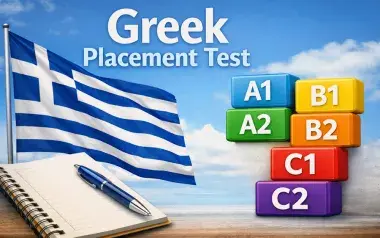
A learner may be strong in reading but hesitant in speaking, or comfortable in conversation but uncertain about endings and spelling. We therefore look beyond a single label: listening, spoken interaction, reading and writing need attention together. Students who have studied Greek before may use our Greek placement test; complete beginners do not automatically need it.
Modern Greek vs Ancient Greek and Koine Greek: Which Should You Learn?
Choose Modern Greek if your goal is to speak, understand, read and write the language used in Greece today. Ancient Greek is studied primarily for historical language and literature, while Koine Greek is particularly relevant to learners interested in Hellenistic and early Christian texts. These are connected stages and varieties of Greek, but each calls for a different learning emphasis. Knowledge of an older form can help you notice familiar words or structures without automatically making contemporary conversation understandable.
| Language focus | What you study | Best suited to |
|---|---|---|
| Modern Greek (Νέα Ελληνικά) | Contemporary speech, pronunciation, writing and practical communication | Life in Greece, family, work, studies and present-day media |
| Ancient Greek | Historical grammatical systems and classical texts | Classical literature, ancient history and specialist academic study |
| Koine Greek | Greek of the Hellenistic and early Roman periods, including many early Christian writings | Historical, religious and textual study |
These categories are not identical to the language's entire historical evolution, and the pronunciation used in an Ancient or Koine Greek classroom may differ from today's pronunciation. At Philoxenia, our adult programmes focus on Modern Greek as a living language, rather than offering specialist classical-text instruction.
Modern Greek Alphabet and Pronunciation for Beginners
The Modern Greek alphabet has 24 letters. Learning it makes everyday written Greek—from shop signs and menus to text messages and transport notices—more accessible. Beginners do not need to master the alphabet before joining an A1 group; reading and speech can develop together through guided practice.
Why familiar-looking Greek letters may sound different
Some letters are recognizable from mathematics or other contexts, but Greek spelling needs to be learned on its own terms. For instance, β is pronounced like the English v, not b; η, ι and υ all represent an /i/ sound in standard Modern Greek. The letter combinations αι, ει, οι and ου are common, and they do not sound like a simple sequence of the corresponding English letter names.
Stress marks, letter combinations and intelligible speech
The written accent mark, or tonos (τόνος), helps readers identify word stress: compare πότε (“when?”) with ποτέ (“never” or “ever,” depending on context). The combinations αυ and ευ change their consonant sound according to what follows; compare αυτό and αύριο. Learning these patterns early is more useful than relying indefinitely on English-letter transliterations.
Pronunciation practice aims to make your speech clear and understandable, not to demand a flawless native-like accent. Listening and speaking gradually reinforce reading and spelling: you hear a word, recognize its written form, and use it in a meaningful exchange.
Is Modern Greek Hard to Learn? A Practical Look at Its Grammar
Modern Greek can be challenging for English-speaking beginners because it has a different alphabet, grammatical gender, noun cases and a rich system of verb forms. Difficulty, however, is not uniform: reading may improve faster than listening, while familiar vocabulary can make simple conversations easier before more complex grammar feels comfortable. Clear examples and repeated use help students approach each feature progressively.
Gender, articles and noun cases in everyday Greek
Modern Greek uses masculine, feminine and neuter grammatical gender. A noun normally appears with an article, so learning ο φίλος (male friend), η φίλη (female friend) and το βιβλίο (book) as complete expressions can be more useful than memorising words without context. Noun endings and articles may change according to a word's function in the sentence; learners meet those changes through practical questions, requests and descriptions.
Greek verbs: learning meaning as well as forms
Verbs express not only time but also ways of viewing an action. For example, γράφω (“I write / I am writing”), έγραψα (“I wrote”) and θα γράψω (“I will write”) show useful contrasts that become clearer within short texts and conversations. Students progress from frequent patterns to more complex distinctions instead of learning every conjugation at once.
Modern Greek Courses for Adult Beginners: A Practical Starting Point
Modern Greek for adults begins with practical communication and does not require prior knowledge of the alphabet or a background in classical languages. A complete beginner can start with the sounds and letters used in contemporary Greek while learning simple, immediately useful expressions. At Philoxenia, we connect reading and pronunciation to communication from the beginning, so alphabet practice has a clear purpose.
An early Modern Greek lesson might help you introduce yourself, ask where something is, understand a price or make a polite request. Instead of expecting fluent speech immediately, we build accuracy and confidence through comprehensible examples, repetition and interaction. As students progress, familiar situations lead to longer exchanges, more detailed descriptions and increasingly independent communication.
Some adult learners have studied Greek before but are uncertain whether they should begin at A1. Knowing letters, isolated words or a few expressions does not mean that A1 has been completed. If you have previously studied Greek and may be ready for a higher-level group, we can use our Greek placement test to help assess your starting point. Complete beginners do not automatically need a test.
How to Start Learning Modern Greek: A Beginner's Roadmap
When you are starting from zero, the most useful first step is understanding and saying a small number of everyday expressions while becoming familiar with Greek letters and sounds. The sequence below is a learning guide, not a fixed timetable or a promise of proficiency after a particular number of days.
- Connect sounds with letters. Practise the alphabet and word stress through short, useful words rather than isolated memorisation alone.
- Build your first exchanges. Learn greetings, introductions and polite questions such as Καλημέρα (good morning) and Πώς σε λένε; (what is your name?).
- Use phrases in context. Practise asking for a price, ordering something or finding a place, while noticing the grammar those tasks require.
- Train listening and speaking together. Listen to level-appropriate speech, respond out loud and ask for repetition or clarification.
- Review and widen your range. Revisit useful phrases, read simple contemporary texts and gradually describe experiences and opinions.
If you have previous Greek study, or understand spoken family Greek but cannot read or speak confidently, you may need a different starting point. We can discuss your background and use our placement test where appropriate; it is not automatically required for complete A1 beginners.
Learn Modern Greek for Work, Family and Life in Greece
Adults learning Greek are not one type of student. Some want to speak with a Greek partner or relatives. Others are relocating to Thessaloniki, preparing for university, working with Greek-speaking colleagues or planning a longer stay in Greece. Our teaching draws on those motivations without confusing a personal goal with a promised CEFR result.
- Modern Greek for everyday life: communicate at shops, cafés, appointments and local services, with language that becomes more complex as your skills grow.
- Modern Greek for work: develop appropriate expressions for emails, meetings, schedules, questions and workplace communication; specialist goals can be addressed through Business & Professional Greek.
- Modern Greek for family and heritage learners: build confidence replying in Greek, following conversations and improving literacy when spoken familiarity is stronger than reading or grammar.
- Modern Greek for studies and certification: develop reading, listening, writing and speaking skills relevant to the learner's target level, including preparation for official examinations where appropriate.
Because these goals call for different priorities, we first clarify what you need to do in Greek, how much you already know and how much time you can study. That information helps us recommend an appropriate group pathway or discuss individually planned lessons.
Modern Greek for Heritage Learners: When Understanding Comes Before Speaking
Some adults grew up hearing Greek at home but had limited opportunities to read, write or answer in the language. They may understand familiar family conversations yet struggle with spelling, grammar or spontaneous speech. This is not the same starting profile as a beginner who has never heard Greek, and it should not automatically be assigned a CEFR level on the basis of family background alone.
For these learners, a useful pathway combines an assessment of existing strengths with opportunities to practise active speaking and written Greek. A learner may need targeted support for literacy or accuracy, a suitable group with regular speaking interaction, or individually arranged lessons focused on a specific gap. We use previous experience and current skills, rather than assumptions about heritage, to discuss an appropriate route.
How We Teach Modern Greek: Grammar in Service of Communication
Speaking practice is essential, but speaking well also requires language structure. Modern Greek involves grammatical gender, cases, verb forms and distinctions of time and aspect. We do not treat those features as an obstacle to be avoided, or expect students to master them through memorised lists alone. Instead, a lesson can connect a form with something the learner wants to say.
For example, a beginner learning to order food practises polite requests and common nouns; a learner describing a recent trip practises past-time expressions and appropriate verb forms; an advanced student works on nuance, register and argument. A useful learning cycle moves from understandable examples to guided practice, real communication and specific feedback. Clear explanations remain important when a concept is unfamiliar; “immersion” should not mean leaving students confused.
Why listening and pronunciation matter from the beginning
Greek uses a different writing system from English, and several letter combinations represent sounds that newcomers may not expect. Reading an alphabet chart is an important first step, but it does not automatically make natural speech easy to follow. Guided listening helps learners notice connected speech, common expressions and the rhythm of everyday Greek; pronunciation practice makes their own communication easier to understand.
Why writing and reading are part of practical Greek
Even students primarily interested in conversation encounter Greek in messages, menus, notices, forms, emails and transport information. Short reading and writing tasks can reinforce vocabulary and show where grammar needs attention. At higher levels, students work toward the more demanding texts and written communication relevant to their goals.
How to Improve Your Modern Greek Speaking and Listening Skills
Adult learners often understand explanations but hesitate when they must respond to real speech. In our Modern Greek classes, speaking and listening are connected: students listen for meaning, practise a manageable response, receive teacher feedback and then use the language again in a new context. This approach makes conversation more than memorising dialogues.
For example, a beginner may practise asking someone to repeat a question, while a more experienced student learns to clarify an appointment, explain a problem or express a qualified opinion. Listening practice should include natural rhythm and common expressions, alongside slower and more structured material that suits the learner's level.
Pronunciation work supports intelligibility, including Greek word stress and sounds that may be unfamiliar to speakers of other languages. Grammar supports this process rather than competing with it: students learn the forms they need to ask, describe, explain and respond. The goal is gradually greater independence, not perfect speech after a predetermined number of classes.
Modern Greek Grammar, Vocabulary and Reading: Building Connected Skills
Modern Greek grammar includes articles, grammatical gender, cases, verb conjugations and distinctions in verbal aspect. Adults may encounter these features for the first time, or recognise some of them from earlier study without knowing how to use them naturally. Our lessons connect each structure to a communicative purpose and provide opportunities to revisit it through listening, speaking, reading and writing.
Vocabulary also becomes more useful when it is learned in context. A word seen on a street sign, heard in conversation and then used in a sentence is more meaningful than an isolated translation. Short contemporary texts, announcements, messages and everyday written expressions can support that process at appropriate levels. These are examples of the skills we develop, not a promise that every lesson uses an identical set of activities.
Learning Modern Greek in Thessaloniki: From Lessons to Everyday Conversations
Studying in Thessaloniki gives learners opportunities to connect lessons with everyday Modern Greek. Ordering something, recognising a street sign, checking a timetable or asking a simple question can turn classroom language into a meaningful task. These small interactions are useful precisely because they recur. The city offers many contexts for practice, but living in Greece alone does not guarantee fluency.
We encourage manageable goals: prepare a phrase in class, try it in a familiar situation, note the response and return to the next lesson with questions. A beginner might practise greetings and prices; an intermediate learner might explain a problem or express an opinion. More complex language becomes useful as the student develops. For a closer look at experience-led learning, explore our Greek learning and immersion guide for Thessaloniki. Activities differ by programme, and city excursions should not be assumed to form part of every group class.
Learn Modern Greek Online or In Person: What to Consider
Live online Greek classes can provide structured learning when students can interact with a teacher, practise speaking and receive correction. They are different from watching recorded explanations or working through vocabulary apps independently. A useful online routine includes scheduled participation, preparation and practice between meetings.
Philoxenia offers online attendance within available Intensive and Superintensive groups. These are live classes following the group's schedule—not a separate self-paced programme with unlimited start dates. If you live overseas, we can discuss your level, time zone and availability before confirming whether a suitable group exists. Students can also ask about one-to-one online Greek lessons arranged according to their needs and teacher availability.
Our Modern Greek courses for adults are available in different formats. Our live online options follow the teaching structure of available Intensive and Superintensive groups. The distinction is their weekly pace, not a separate online syllabus: students attend scheduled classes, practise language in real time and continue reviewing between sessions. If a group schedule does not suit your time zone or work commitments, you can ask us about individually arranged private Modern Greek lessons, subject to teacher availability.
How Long Does It Take to Learn Modern Greek?
There is no single number of months required to learn Modern Greek. Your starting level, the range of situations you need to handle, class participation and consistent practice all matter. Being able to order a coffee or introduce yourself is a different goal from following a workplace meeting, reading academic texts or passing an official proficiency examination.
From first conversations to independent communication
At A1, learners work toward simple introductions and familiar exchanges; at A2, routine tasks and short conversations become more manageable. B1 focuses on greater independence in familiar situations, and B2 on sustained interaction and more demanding content. C1 and C2 involve increasing nuance, flexibility and precision. These descriptors explain the kind of ability students are working toward, not a universal speed of learning.
Course duration is not the same as a guaranteed CEFR result
Our eight-month Intensive and three-month Superintensive programmes each cover the curriculum of two consecutive CEFR levels; our four-week Seasonal and Summer programmes cover the curriculum for one level. Covering a syllabus does not automatically establish an individual CEFR qualification. We recommend choosing a study schedule you can maintain and reviewing your actual language abilities as you progress.
Can You Learn Modern Greek by Yourself, or Do You Need Classes?
Independent study can build valuable Modern Greek skills, especially alphabet recognition, vocabulary recall, listening familiarity and regular reading. Textbooks, recordings, videos and language-learning apps can support these habits. Their limitation is that learners may receive little personalised feedback on misunderstandings, pronunciation or spontaneous conversations.
Live classes add structured progression, interaction and an opportunity to ask why a particular expression works. Our enrolled students can also use Babylonia Language Lab for supplementary independent practice. These approaches work together rather than forming an all-or-nothing choice: independent exposure reinforces lessons, while teacher feedback helps learners apply knowledge accurately.
How Much Study Is Enough? Choose a Rhythm You Can Keep
There is no universally correct number of weekly hours for learning Modern Greek. Progress depends on your starting point, attendance, exposure, meaningful practice and the kind of communication you want to develop. More classroom hours can provide more guided opportunities, but a heavier timetable also requires attention and time for consolidation.
If you have a full-time job, consistent study across several months may be more practical than a compressed schedule you cannot maintain. If you have a shorter period available, a higher-frequency course may be appropriate. Small amounts of independent listening, reading, recall and conversation between sessions matter in either case. For official examinations, planning should also take account of the skills tested and the student's current readiness, not only the planned course end date.
Our programmes differ in learning intensity, length and purpose. An eight-month route serves a different need from a four-week course; a seven-day city experience is not equivalent to a full CEFR syllabus; individual lessons can address a specific weakness without following a group's pace. The comparison below is intended to help you make that first decision and then open the detailed page for the relevant programme.
Compare Modern Greek Language Courses by Duration and Learning Goal
The table shows the course structure in the current Philoxenia programme portfolio. All hour totals labelled teaching hours are academic teaching hours. Study Holidays uses a different measure of combined learning and city-activity time.
| Programme | Duration | Learning load | Attendance | Best suited to |
|---|---|---|---|---|
| Intensive Greek Courses | 8 months | 4 teaching hours/week; 128 total; two consecutive CEFR levels of curriculum | In-person, live online or hybrid, subject to group availability | Longer-term, steady study alongside other commitments |
| Superintensive Greek Courses | 3 months | 10 teaching hours/week; 120 total; two consecutive CEFR levels of curriculum | In-person, live online or hybrid, subject to group availability | Learners able to follow a high-frequency weekday schedule |
| Seasonal Intensive Greek | 4 weeks | 60 teaching hours; one CEFR level of curriculum | In person, Thessaloniki | Focused short-term study in winter, spring or autumn |
| Summer Greek Course | 4 weeks | 60 teaching hours; one CEFR level of curriculum | In person, Thessaloniki | Combining structured summer learning with time in Greece |
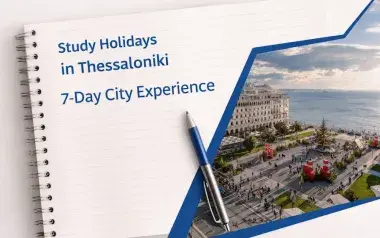
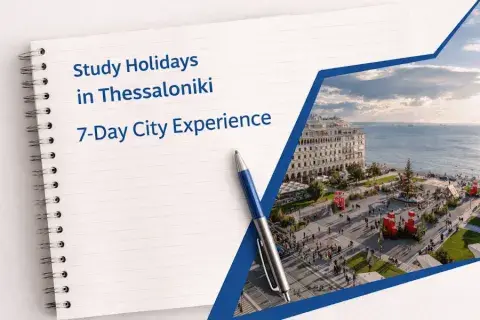
| Study Holidays – 7-Day City Experience | 7 days | Approximately 35 structured learning and city-activity hours, not 35 classroom teaching hours | In person, Thessaloniki | A short language-and-culture experience |
| Survival Greek | 2 months | 8 weekly sessions; 20 teaching hours; not a full CEFR level | In person, Thessaloniki | Practical everyday communication for newcomers |
| Private Greek Lessons | Individual plan | Teaching hours and lesson package tailored to your needs | In person or live online, subject to teacher availability | Specific learning goals and individually arranged teaching |
Programme schedules and level groups depend on formation and availability. Published intake periods describe planned course windows rather than a promise that every group or time slot is confirmed.
Intensive Greek Courses: A Sustainable Path from A1 to C2
Our eight-month Intensive Greek programme meets on two days per week, with two teaching hours per meeting. The full cycle has 128 teaching hours and covers the syllabus of two consecutive CEFR levels: A1–A2, B1–B2 or C1–C2.
This rhythm gives learners more time between classes for revision and independent practice. It can be a useful choice if you work, study or have family commitments, while still wanting an organised academic route. Planned entry options include an October cycle and a February-start pathway; confirm the relevant level group and final timetable with us before making arrangements.
Superintensive Greek Courses: Daily Live Instruction
Our three-month Superintensive Greek programme meets on weekdays for two academic teaching hours per day: 10 teaching hours weekly and 120 teaching hours over the cycle. The course covers the curriculum for two consecutive CEFR levels.
Because the programme moves quickly, it suits students who can participate regularly and review what they learn outside class. It may be appropriate for learners with a near-term relocation, study or professional goal, but intensive scheduling does not guarantee a particular exam result or that every learner will reach the same level within three months. Planned winter, spring and autumn intakes are described on the detailed course page.
Online and in-person participation follow the relevant group's timetable. If you work across time zones, send us your location and realistic time windows so that we can check which available group, if any, is suitable. See our live online Greek courses overview for more about this learning format.
Short-Term Modern Greek Courses in Thessaloniki
If you will be in Thessaloniki for only a few weeks, our Seasonal Intensive and Summer Greek courses provide a structured four-week option. Each includes 60 teaching hours and covers the curriculum for one CEFR level. The programme combines classroom learning with practical activities; individual language outcomes still depend on starting level, attendance and study.
For a different purpose, our seven-day Study Holidays combines Greek learning with planned cultural and city-based activities. Its approximately 35 structured hours should not be confused with a 35-hour classroom course. Students who need essential Greek for shopping, services and local daily life can instead consider our two-month Survival Greek programme, which develops practical communication without claiming to complete a full CEFR level.
Private Modern Greek Lessons for Individual Goals
Group study is not the only option. In our private Greek lessons, we plan the package and teaching hours around your current ability, learning needs, goals and availability. Lessons can support everyday communication, speaking confidence, exam preparation, specific workplace tasks or targeted revision.
Individual lessons are requested for online or in-person attendance, but an exact schedule is confirmed only after we check teacher availability. For occupational communication, see Business & Professional Greek for Work.
At beginner levels we work on essential vocabulary, pronunciation, short exchanges, reading and basic writing. As learners develop, activities can involve explaining opinions, handling less familiar situations, understanding longer texts and producing more precise written and spoken Greek. Curriculum coverage and actual proficiency are different: progress depends on the student and cannot be guaranteed solely by completing scheduled teaching hours.
Read our practical Survival Greek programme and Study Holidays if everyday communication and local culture are central to your goals. Activity arrangements vary between programmes and should not be assumed to be identical in every course.
Greek Examination Preparation and University Study Goals
Students who need evidence of Greek-language proficiency can prepare for the Certificate of Attainment in Greek (Ελληνομάθεια). We teach Greek and help learners prepare for official examination tasks; the official certificate is awarded through the Centre for the Greek Language's examination process, not by Philoxenia. The certificate and level required for a particular university or professional purpose must be checked with the receiving institution.
Tell us your existing Greek knowledge and target examination or application deadline so that we can discuss an appropriate study pathway. We cannot guarantee an exam pass or university admission. Official requirements, registration procedures and examination dates should also be checked through the Centre for the Greek Language certification website.
Free Supplementary Greek Practice with Babylonia Language Lab
All enrolled Philoxenia students have free access to Babylonia Language Lab as a supplementary learning resource. This offers an additional way to review alongside teacher-led lessons. Required course textbooks are purchased separately and are not included in tuition.
How to Choose and Register for Your Modern Greek Course
- Identify your objective. Tell us whether Greek is for daily life, work, family, study or an official examination.
- Choose the study rhythm. Compare Intensive, Superintensive, short-term programmes and private lessons according to your schedule.
- Share your current level. Complete A1 beginners do not automatically need a placement test. If you have previously studied Greek, our placement test may help identify a suitable level.
- Request the right attendance option. Indicate in-person, live online or hybrid preferences where available; we confirm group and teacher availability before an exact timetable is final.
- Complete registration. Use our Greek course registration form, and consult our payment methods when arranging tuition payment.
Choosing a Modern Greek Course
Modern Greek Course Questions Before You Enrol
Practical answers from our school to decisions that may not be clear from course descriptions alone.
Can I start learning Modern Greek before moving to Thessaloniki and continue after I arrive?
Yes. We offer live online participation within available Intensive and Superintensive groups, as well as individually arranged private lessons, so you can begin before relocating.
If you later want to attend in person, tell us your arrival date and current group; we will check whether the change is possible within the relevant arrangements. We cannot promise an automatic transfer to a particular classroom or timetable.
I work full time. How do I choose a Greek class without committing to a timetable I cannot keep?
We recommend comparing your genuinely available study time with the weekly commitment before selecting a course.
Intensive requires a regular four-teaching-hour week, while Superintensive has weekday classes and requires more time for practice. If neither group timetable fits, ask us about an individually planned private lesson package. We confirm available timetables rather than guaranteeing any requested time.
I have studied Greek independently but freeze when someone speaks to me. What should I focus on?
We would focus on listening to natural speech, guided conversation and repeated real-world exchanges, while reinforcing the grammar and vocabulary you already know.
Tell us which situations are hardest for you. We can then discuss a suitable group level or targeted private lessons; prior self-study does not automatically indicate that an entire CEFR level has been completed.
Are live online Greek classes different from working through an app or recorded videos?
Yes. In our live online group classes, an instructor leads the lesson in real time, so students can practise communication, ask questions and receive feedback.
Independent digital practice can still be useful between lessons. Our enrolled students also receive free access to Babylonia Language Lab; it supplements rather than replaces scheduled teaching.
What if I want to learn Greek for a very specific task rather than follow a full group course?
We can discuss private lessons centred on a defined goal, such as a workplace conversation, a presentation, an appointment or a particular language skill.
Send us the situation, your current level and the time you can dedicate to study. We will help determine a realistic scope and teaching-hour package, then check teacher availability before confirming any sessions.
What if the available Greek group is above or below my current level?
We will discuss your previous learning and the level currently taught before recommending a group; we do not place students into an unsuitable class simply because a timetable is available.
If you have studied Greek before, our Greek placement test may help clarify your starting point. If no suitable group is available, we can discuss private lessons subject to teacher availability.
Can I join an Intensive Greek group if its course has already started?
It may be possible to join an ongoing long-term group if there is a place and your existing Greek knowledge matches what the group is currently studying.
We do not charge you for group teaching hours that took place before you joined. If you need to cover missed material first, we can discuss separately arranged, paid private lessons before joining the group. Admission is not automatic and depends on the group's availability and your readiness.
What if the group course moves too quickly for me in grammar or speaking?
Tell us which parts of the course are difficult so we can identify whether you need focused revision, more independent practice or a different learning arrangement.
We can discuss individually planned private Greek lessons to address specific gaps while you continue in an appropriate group. This is a separate teaching arrangement, subject to teacher availability; it does not change the group's pace or guarantee a particular result.
How can I practise Greek in Thessaloniki when people answer me in English?
Start with short, familiar exchanges and politely ask whether you can continue in Greek. We encourage students to practise manageable language tasks rather than depend on a long conversation going perfectly.
For example, you can say «Μπορούμε να μιλήσουμε ελληνικά; Μαθαίνω ελληνικά.» (“Can we speak Greek? I’m learning Greek.”). Use everyday situations such as ordering something or asking for directions, then bring unfamiliar words or difficulties back to your lessons for guided correction.
How many letters are in the Modern Greek alphabet, and must I learn them before A1?
Modern Greek has 24 letters. You do not need to know all of them before starting our A1 beginner pathway. We introduce letters, sounds and common expressions as part of learning to communicate; regular practice helps reading become more automatic.
Is Modern Greek harder than Ancient Greek for everyday conversation?
The two are studied for different purposes, so a simple difficulty ranking is misleading. Modern Greek is the appropriate choice for everyday conversations in present-day Greece; Ancient and Koine Greek studies generally focus on historical texts and language. Prior Ancient Greek knowledge may help with recognition but does not replace Modern Greek listening and speaking practice.
How do I know whether I am ready to move from A1 to A2 in Modern Greek?
Look at what you can understand and do, not only the number of lessons attended: can you handle familiar questions, short interactions and simple written messages with appropriate support? Your teacher can help review your strengths and gaps. Finishing the A1 syllabus does not by itself guarantee an external CEFR result or automatic entry into a particular group.
Why do I recognise written Greek but struggle to understand it when people speak?
Written words remain visible while spontaneous speech includes rhythm, connected sounds and expressions that may be unfamiliar at first. Short, level-appropriate listening activities, repeated exposure and practice responding to understandable speech can help. Tell us whether listening, speaking or reading is most difficult so we can discuss suitable support.
Learn Modern Greek with Philoxenia Greek Language School
We welcome adult learners who want a clear learning structure, teaching that responds to real communication needs and an appropriate course format. Whether you want to join us in central Thessaloniki or learn with us live online, the next step is to tell us what you want to achieve and how much time you can dedicate to it.
Philoxenia Greek Language School · Egnatia 45, Thessaloniki City Centre · Tel. 2310 53 5444 · Mobile 694 723 8850 · info@greeklanguageschool.com · Course registration